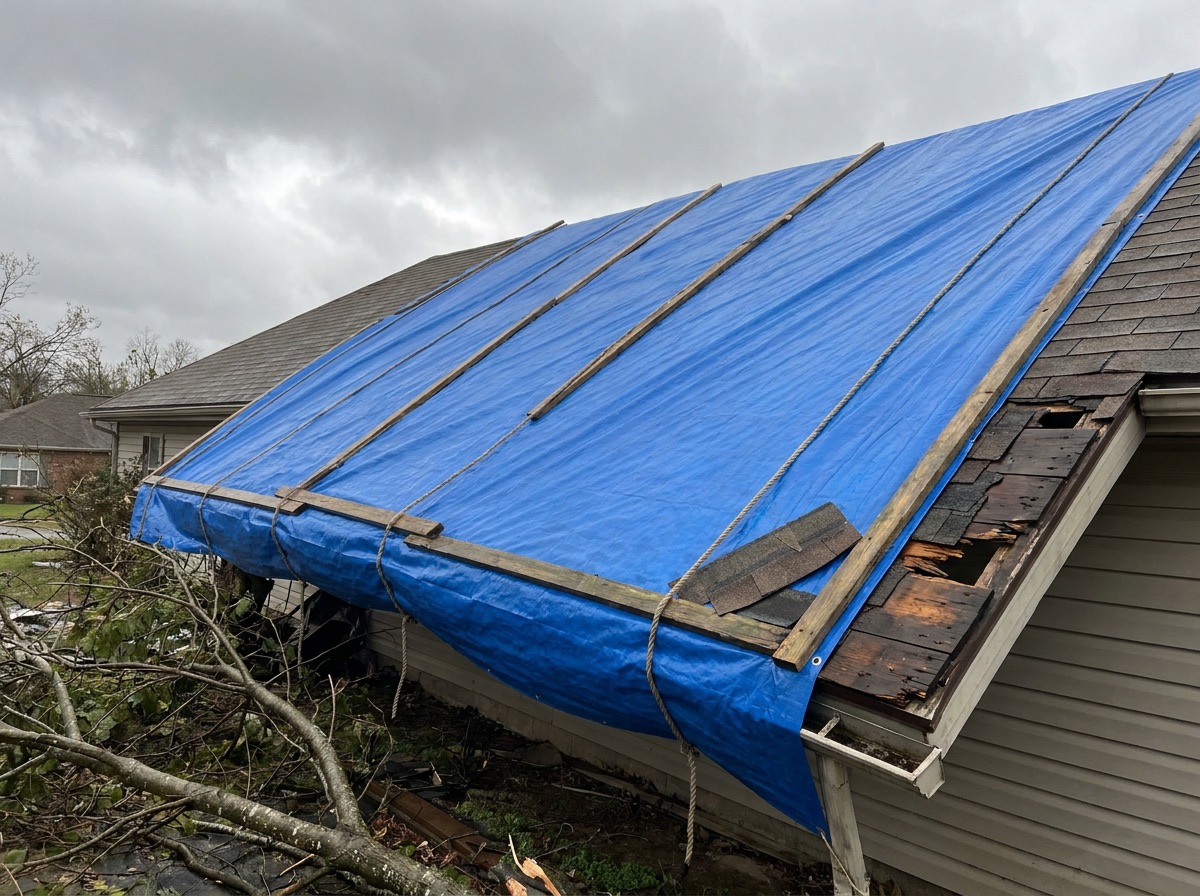
Roof & Opening Board-Up in Aurora
Boarding up roof openings, windows, and doors after storm damage. We connect Aurora homeowners with vetted, licensed local pros, free.
Board-Up in Aurora
Free, no obligation. We match you with up to two licensed, insured local pros so you can compare.
- Licensed pros
- Free, no spam
- One call, not eight
Got it. You are in good hands.
A vetted local pro will reach out shortly. For an active emergency, call us now at (813) 555-0911.
Aurora homeowners turn to roof & opening board-up after the storms that hit Kane County. Here is exactly what the work involves, what it costs, and how to get matched with a local pro.
Roof and opening board-up is the structural companion to roof tarping: where tarps cover the roof plane, board-up services seal the vertical and angled openings - shattered windows, blown-in doors, collapsed skylights, and large holes in gable ends or soffits - that a tarp alone cannot address. After a tornado, severe thunderstorm, or hurricane passes through Illinois or Florida, a home can be simultaneously exposed through multiple points of entry. A professional board-up crew cuts and installs plywood panels over each compromised opening, secures them with framing screws or pneumatic fasteners driven into the structural framing around the opening rather than finished surfaces, and adds weatherproofing caulk at gaps. In Florida's High Velocity Hurricane Zone, board-up work on occupied structures during an active storm must meet specific Miami-Dade wind-load standards. In Illinois, board-up after tornado or severe wind events frequently involves stabilizing partially collapsed wall sections before panels can be installed safely.
When you need itSigns you need this service
- One or more windows shattered or frames blown out by wind pressure or debris impact
- Entry doors or garage doors buckled, blown off hinges, or pushed inward by storm pressure
- Skylights broken, cracked, or lifted from their frames
- Gable-end vents or soffit sections collapsed, creating large open gaps into the attic
- Partial wall collapse from tree impact or structural failure exposing interior rooms
- Roof decking holes large enough that a tarp alone does not seal the opening from driving rain and wind
How it works
- Site safety assessmentThe crew evaluates structural stability before approaching any opening - downed power lines, compromised load-bearing walls, and gas leak indicators are verified safe or flagged for utility response before board-up work begins.
- Opening inventory and measurementEvery compromised opening - windows, doors, skylights, gable vents, roof holes larger than 12 inches - is measured precisely and inventoried. Plywood sheets (typically 5/8" or 3/4" CDX) are cut to match each opening, accounting for overlap onto surrounding solid framing or masonry.
- Frame preparation and debris clearingBroken glass, splintered frame material, and any structural debris blocking the opening perimeter are removed so panels seat flush against solid framing. This step determines whether additional framing nailers must be added to provide a sound fastening surface.
- Panel installation and fasteningPanels are secured with 3-inch framing screws or structural nails driven into the king studs, headers, and sill plates around each opening - not into sheathing alone. Roof holes receive panels fastened to rafters or engineered to span across undamaged decking on both sides of the void.
- Weatherproofing and sealingPanel edges are caulked with an exterior-grade elastomeric caulk to prevent wind-driven rain infiltration around the plywood perimeter. Large or unusually shaped openings may receive a secondary layer of poly sheeting under the panel for added moisture barrier.
- Condition documentationPhotos are taken of each opening before boarding and of finished panels from interior and exterior angles, providing an insurance-ready record of pre-board damage extent and the work performed.
What it costs
Individual window board-ups average $50-$250 per opening depending on size and floor level; large picture windows, sliding glass doors, and second-story openings approach $400-$500 each. A whole-home board-up after significant storm damage - covering 8-15 openings plus roof holes - typically totals $800-$2,500 for labor and materials. The primary cost drivers are panel count, opening height (second-story work requires additional ladder setup time), and whether structural framing nailers must be added where the original framing was damaged. Emergency same-day or overnight service typically adds a flat dispatch fee of $100-$300.
Board-Up in Aurora: questions
Do you offer board-up in Aurora?
Yes. We connect Aurora homeowners with vetted, licensed local pros for roof & opening board-up, with a free assessment and no obligation.
How fast can someone help with board-up in Aurora?
For Aurora and the surrounding Kane County area, our network pros prioritize storm work and typically respond same-day or next-day for urgent needs.
What thickness of plywood is used for board-up, and does it matter?
Standard emergency board-up uses 5/8" or 3/4" CDX plywood, which is the minimum thickness most building departments and insurance carriers recognize as adequate temporary protection. Thinner OSB or 1/2" panels are sometimes used for small interior openings in sheltered locations but are generally not appropriate for exterior windows and doors exposed to continued weather. In Florida's HVHZ, 3/4" panels with specific fastening patterns are required to meet wind-load compliance.
How long can boards stay up before the underlying damage gets worse?
Properly installed plywood boards provide adequate protection for 30-60 days in most conditions. Extended periods beyond 60 days in Florida's summer humidity accelerate moisture absorption into the plywood and surrounding framing, and boards can warp, swell, and loosen fasteners. In Illinois winters, temperature cycling causes wood to expand and contract, eventually loosening the seal. Permanent repairs should be scheduled well within the 60-day window.
Can I use board-up on an occupied home, or do residents need to leave?
Board-up is entirely compatible with continued occupancy in most cases. The work is performed from the exterior, and windows and doors are sealed from outside. Interior access is only needed for unusually large or structurally complex openings. Residents should avoid the specific room where work is occurring during installation. If structural instability is present in the affected area, the contractor will advise on whether that section of the home should be vacated during repairs.
Does boarding up windows and doors affect my insurance claim?
Boarding up is a protective mitigation action and is typically covered under the same emergency mitigation provision as roof tarping. Documenting the pre-board condition with photographs is the critical step - insurers need to see the original damage, not just panels covering it. Keep itemized receipts from the contractor showing the number of openings, materials, and labor. This documentation supports both mitigation cost reimbursement and the underlying damage claim.
My garage door was blown in. Does board-up work for that?
Yes, large garage door openings are one of the most common board-up jobs after severe storms, particularly in Florida where hurricane winds frequently overload residential garage doors. A crew will frame a temporary support structure across the opening using 2x4 horizontal nailers secured to the surrounding masonry or wood framing, then sheet the full opening with 3/4" plywood panels. This is a more labor-intensive job than a standard window board and typically runs $300-$600 per bay.
Is board-up the same as storm shutters or hurricane panels?
No. Storm shutters and hurricane panels are permanent or semi-permanent protective systems installed before a storm arrives. Board-up is an emergency post-damage response - it uses cut plywood or OSB to seal openings where the original window, door, or wall assembly has already been breached. Board-up panels are not rated for repeated storm cycles the way engineered hurricane panels are. If a home suffered recurring damage from board-up-level events, the right long-term solution is impact windows or a rated shutter system.
What do I do if a tree is partially through my wall - can it be boarded up with the tree still in it?
Not immediately and not without coordination. A tree through a wall is a structural emergency: the tree may be load-bearing in the damaged section, and removing it without temporary shoring can cause further collapse. The correct sequence is: contact a structural engineer or the fire department for a stability assessment, arrange safe tree removal by a licensed arborist, then have the board-up crew stabilize the remaining opening. Attempting to cut around a tree and board it in place is generally not safe and will not produce a weathertight result.
Are permits required for emergency board-up in Florida and Illinois?
Emergency board-up is widely exempt from permit requirements in both states because it is classified as temporary protective work rather than a structural repair or alteration. However, if the underlying damage requires a demolition or repair permit - which many jurisdictions require before permanent reconstruction - the permit process for that permanent work will encompass the opening's history. Some municipalities issue emergency damage declarations that fast-track or waive permit fees for both temporary and permanent storm repair work.
Can board-up prevent break-ins after a storm, or is it just for weather?
A properly installed 3/4" plywood board-up with 3-inch structural screws provides meaningful deterrence against opportunistic entry - it is far more resistant than an empty opening and takes tools and significant effort to defeat. It is not equivalent to a reinforced door or impact-rated window, but in the context of post-storm conditions where rapid access is more often the threat than organized burglary, board-up provides a practical security layer. For homes that will be unoccupied for more than a few days post-storm, adding security lighting and notifying local police of vacancy is a useful complement.
Who should I call first - a roofing contractor, a general contractor, or a board-up specialist?
If both roof and opening damage are present, call a full-service storm restoration contractor who handles both simultaneously. Roof-only contractors may not carry the framing materials and panel stock for opening board-up. Dedicated board-up companies exist but may not coordinate with roofing crews. A single storm-restoration call typically gets one crew deployed that assesses the full damage picture and performs both services, which avoids the sequencing delays of managing two separate contractors after an emergency.