Sewage & Black Water Cleanup in Aurora
Safe removal and decontamination after a sewage backup or black-water intrusion. We connect Aurora homeowners with vetted, licensed local pros, free.
Sewage Cleanup in Aurora
Free, no obligation. We match you with up to two licensed, insured local pros so you can compare.
- Licensed pros
- Free, no spam
- One call, not eight
Got it. You are in good hands.
A vetted local pro will reach out shortly. For an active emergency, call us now at (813) 555-0911.
Aurora homeowners turn to sewage & black water cleanup after the storms that hit Kane County. Here is exactly what the work involves, what it costs, and how to get matched with a local pro.
Sewage backup and black-water intrusion are the most hazardous categories of water damage a home can sustain. Under the IICRC S500 standard, this is classified as Category 3 - water grossly contaminated with pathogenic, toxigenic, or other harmful agents that pose an immediate health risk. In Illinois, aging municipal sewer infrastructure in Chicago and surrounding suburbs regularly causes basement sewage backups during heavy storm events when the combined sewer system is overwhelmed. In Florida, storm surge events and drain field failures on older septic systems produce similar black-water intrusions. Every porous surface that contacted sewage - drywall, insulation, carpet, subfloor, furniture - must be removed and disposed of as biohazardous waste. The remaining structure must be decontaminated with EPA-registered hospital-grade disinfectants before any drying or rebuilding begins.
When you need itSigns you need this service
- Raw sewage or black water has backed up through a floor drain, toilet, or basement drain
- A strong sewage odor is present in the home, particularly in bathrooms or the basement
- Brown or black water has come up through any fixture connected to the sewer line
- Stormwater has entered the home during a flood event and mixed with sewage or surface runoff
- A septic system has overflowed into the home's foundation or crawl space
- Any standing water of unknown origin appeared during a storm event, which may have carried sewer contamination
How it works
- Immediate containment and safety establishmentTechnicians arrive in full Category 3 PPE - Tyvek coveralls, N95 or higher respirators, nitrile gloves, and waterproof boots. The affected zone is immediately isolated with plastic sheeting and negative air pressure is established using HEPA-filtered air scrubbers to prevent cross-contamination of clean areas. Occupants and pets are directed to vacate the affected zone.
- Sewage extraction and bulk removalStanding sewage is extracted using pump equipment rated for contaminated water. All extracted liquid is handled as biohazardous waste under applicable EPA and state regulations. Crews document the volume removed and the visible extent of spread, including areas behind walls, under flooring, and in HVAC ducts if affected.
- Removal of all porous contaminated materialsEvery porous material that contacted Category 3 water is removed: carpet, pad, drywall - cut at a minimum 12 to 24 inches above the highest water line - fiberglass insulation, wood baseboards, and any saturated subfloor panels. These materials are double-bagged and disposed of per biohazardous waste protocols. There are no exceptions for porous materials with sewage contact; cleaning in place is not sufficient.
- Full decontamination of structural surfacesAll non-porous structural surfaces - concrete, block, metal, tile, remaining drywall above flood cuts - are cleaned of visible contamination, then treated with EPA-registered hospital-grade disinfectants. Phenolic-based or quaternary ammonium compounds are applied, held at dwell time per label instructions, and the treatment is documented. In some cases, a second disinfection pass is performed after the structure begins drying.
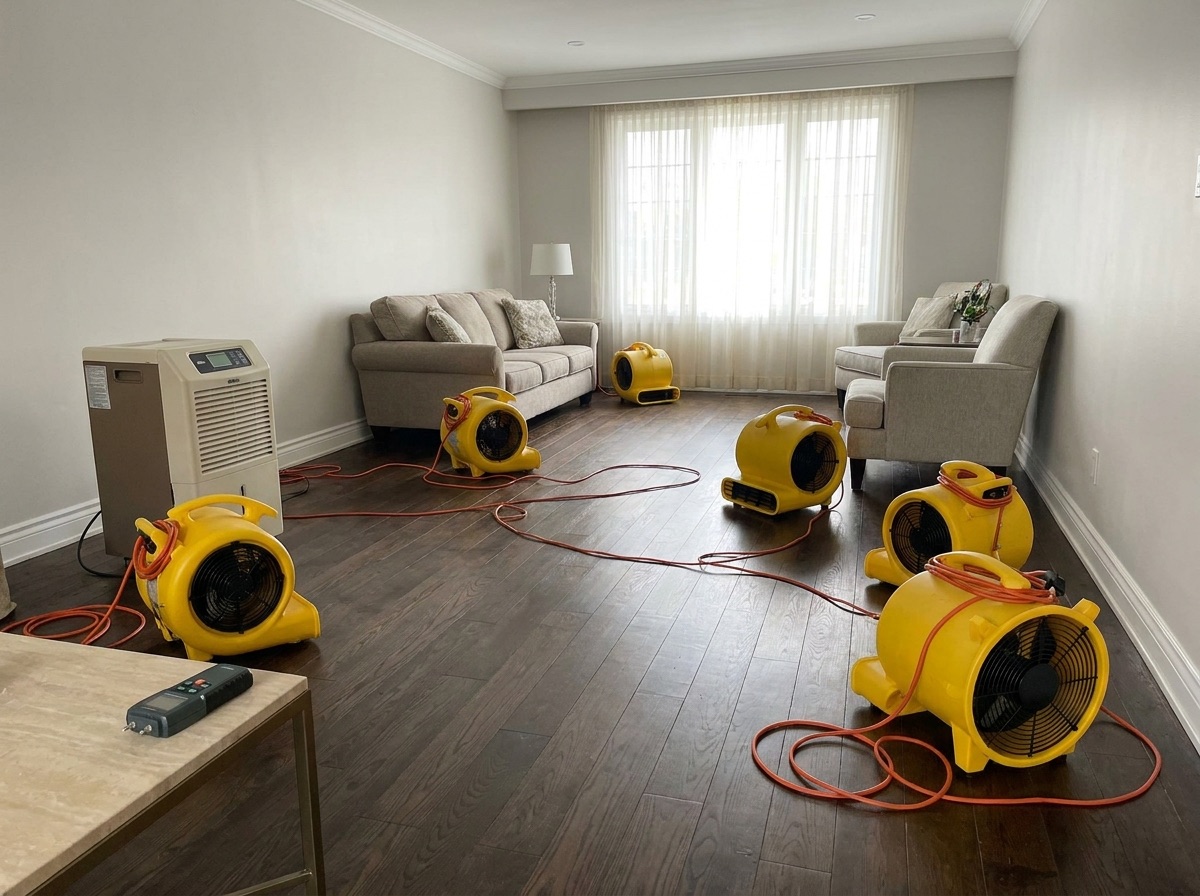
- Structural drying with commercial equipmentOnly after full decontamination does the drying phase begin. Industrial LGR dehumidifiers and high-velocity air movers are placed per IICRC S500 ratios. Daily moisture readings and psychrometric data are logged. Because sewage losses always require significant material removal, drying times are often shorter than a comparable clean-water loss - but confirmation via calibrated equipment is still mandatory.
- Post-remediation verification and clearanceA final inspection confirms all structural surfaces have returned to acceptable moisture content and that no visible mold growth or residual odor is present. Many contractors provide a written clearance document confirming the work met IICRC S500 Category 3 protocols. This documentation is important for insurance claims and for the eventual rebuild contractor working in the same space.
What it costs
Sewage cleanup is priced at roughly $7-$14 per square foot of affected area, but total project costs are heavily influenced by how much porous material must be removed and disposed of as biohazardous waste, and whether the backup reached wall cavities requiring flood cuts. A localized bathroom backup affecting 150 square feet might cost $2,000-$4,000; a basement or multi-room intrusion affecting 500+ square feet with full drywall removal commonly reaches $8,000-$15,000. Structural rebuild - new drywall, flooring, and finishes - is a separate cost on top of the remediation scope.
Sewage Cleanup in Aurora: questions
Do you offer sewage cleanup in Aurora?
Yes. We connect Aurora homeowners with vetted, licensed local pros for sewage & black water cleanup, with a free assessment and no obligation.
How fast can someone help with sewage cleanup in Aurora?
For Aurora and the surrounding Kane County area, our network pros prioritize storm work and typically respond same-day or next-day for urgent needs.
Is sewage backup cleanup something I can do myself?
No. Category 3 sewage water contains pathogens including E. coli, Salmonella, Hepatitis A, Giardia, and norovirus. Without proper PPE, containment, and EPA-registered disinfectants applied at verified dwell times, the space cannot be declared safe for occupancy. Attempting DIY cleanup also voids most insurance claims and creates liability if occupants suffer health effects.
How long can we stay in the home during sewage cleanup?
Occupants should vacate the affected floor or zone entirely during active cleanup. If the sewage backup is contained to a basement or single bathroom and proper containment barriers are in place, upper floors may be habitable. If contamination has spread to primary living areas, HVAC systems, or multiple rooms, temporary relocation is strongly recommended until the decontamination phase is complete and air quality has been verified.
Why does all the drywall have to come out even if it only looks slightly wet?
Category 3 contaminants wick into drywall paper and gypsum core rapidly and invisibly. Drywall that appears only slightly damp at the surface can have sewage contamination throughout its thickness. The IICRC S500 protocol requires removal at least 12 to 24 inches above the visible water line precisely because wicking and capillary action move contamination higher than the standing water level. Leaving contaminated drywall in place, painting over it, or attempting to disinfect it in place is not an accepted remediation practice.
What causes sewage backups in Illinois homes specifically?
Chicago and many of its suburbs use a combined sewer system that carries both stormwater and sewage in the same pipe. During heavy rainfall events - increasingly common with changing precipitation patterns - that system can become overwhelmed, and sewage is pushed back up through basement floor drains and sewer laterals. Aging clay tile laterals are also prone to root intrusion and collapse, which causes backups independent of storm events. A backwater valve on the main sewer lateral is the most effective preventive measure for Chicago-area homes.
Does Florida have the same sewage backup risk as Illinois?
Florida sewage backup risk has a different profile. Full basements are uncommon, but crawl spaces, below-grade utility rooms, and septic systems on older properties create exposure. During hurricane events and severe flooding, municipal lift stations can lose power and sewage can back up through any low-point fixture in the home. Properties on septic systems are at risk when the drain field becomes saturated and the system loses absorption capacity.
What is a backwater valve and does it prevent sewage backup?
A backwater valve (also called a check valve or backflow preventer) is installed on the main sewer lateral below the foundation and contains a flap that allows waste to flow out but closes automatically when flow reverses, preventing sewer water from pushing back into the home. When properly installed and maintained, it is highly effective against municipal sewer surcharge events. Illinois municipalities including Chicago have offered partial rebates for installation. It does not protect against issues with the home's own sewer lateral upstream of the valve.
What gets thrown away versus what can be cleaned?
Non-porous hard surfaces - ceramic tile, concrete block, cast iron, PVC pipe, metal framing - can typically be decontaminated and retained. Porous materials that had direct contact with sewage - carpet, carpet pad, drywall, wood framing that is not structural, fiberglass insulation, wood furniture, upholstery, and clothing - are generally treated as losses and removed. Structural wood framing that was contaminated is evaluated by the contractor; in many cases it can be treated and retained if moisture content returns to normal and disinfection is thorough.
How does sewage cleanup affect my homeowners insurance claim?
Standard homeowners insurance policies often exclude sewer backup unless a specific sewer backup endorsement has been added to the policy. This endorsement is widely available and typically costs relatively little annually - it is worth reviewing your policy before storm season rather than after an event. If you have the endorsement, your insurer will generally cover extraction, decontamination, drying, and structural rebuild up to the endorsement limit. The remediation company's written scope and documentation are central to the claims process.
Can I get sick from a sewage backup even after the water is removed?
Yes. Dried sewage residue on surfaces still carries viable pathogens. Airborne particles disturbed during cleanup or drying can be inhaled. This is why air scrubbers with HEPA filtration are run continuously during the remediation process, and why the space should not be reoccupied until a full decontamination pass has been completed and the crew has given clearance. Symptoms from sewage pathogen exposure can include gastrointestinal illness, skin infections, and respiratory irritation.
How soon after a sewage backup should a remediation crew be on site?
Immediately. Every hour sewage water remains in contact with building materials extends the depth of contamination and the amount of material that must be removed. Pathogen concentrations also increase as standing sewage warms. Most certified restoration companies in Illinois and Florida offer 24/7 emergency dispatch specifically because sewage events are time-critical. Same-day response consistently results in narrower material removal scope and lower total project cost.