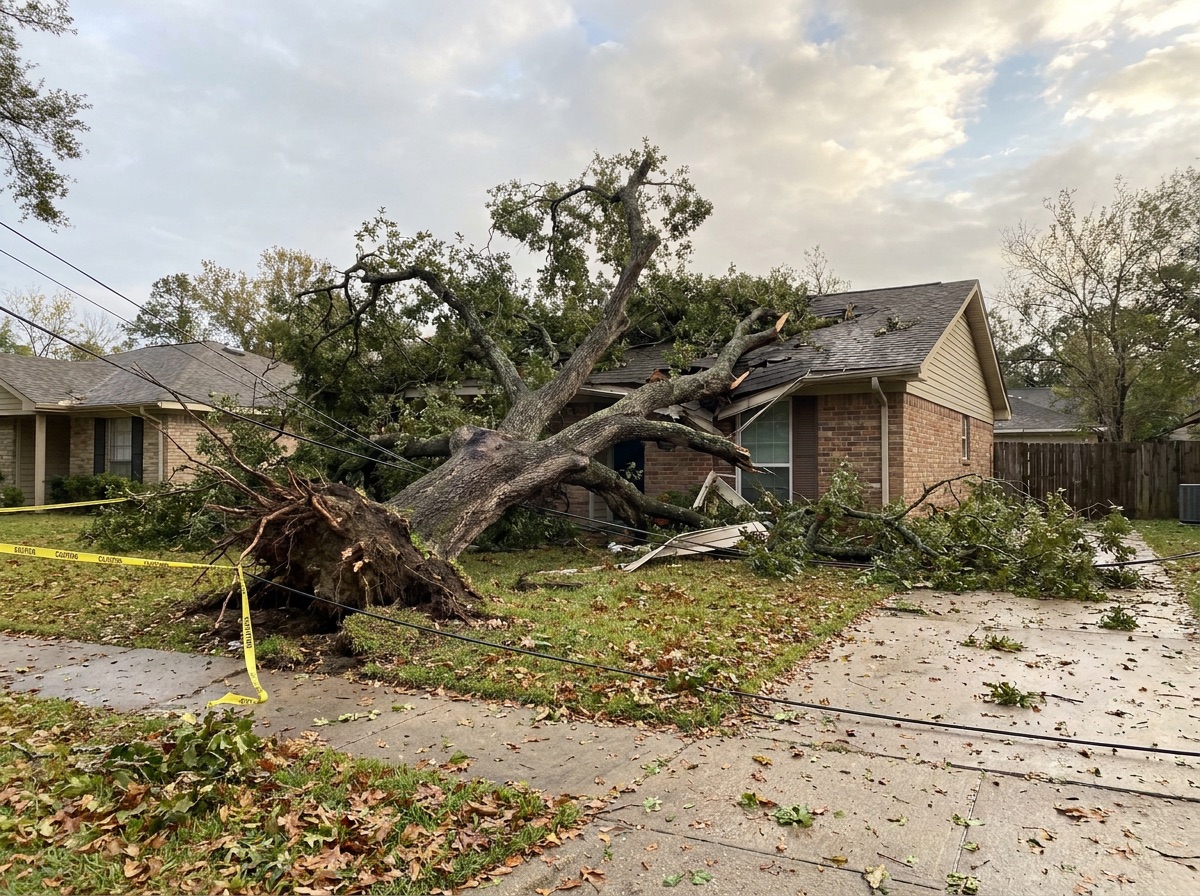
Fallen Tree on House Removal in Jacksonville
Safe removal of a tree that has fallen onto a home or structure. We connect Jacksonville homeowners with vetted, licensed local pros, free.
Tree on House in Jacksonville
Free, no obligation. We match you with up to two licensed, insured local pros so you can compare.
- Licensed pros
- Free, no spam
- One call, not eight
Got it. You are in good hands.
A vetted local pro will reach out shortly. For an active emergency, call us now at (813) 555-0911.
Jacksonville homeowners turn to fallen tree on house removal after the storms that hit Duval County. Here is exactly what the work involves, what it costs, and how to get matched with a local pro.
When a storm drops a tree onto a home, the hazard is not limited to the visible impact point. The tree transfers continuous load to the roof deck, rafters, and walls beneath it, and that load increases as the tree absorbs rain and as the structure beneath weakens. Secondary hazards - downed power lines, gas leaks, compromised load-bearing walls - can make a fallen-tree scene life-threatening. Fallen tree removal from a structure is a distinct discipline from standard tree removal: it requires coordination between certified arborists, rigging specialists, and structural assessors who can evaluate how much of the tree's weight the damaged structure can bear during sectional cutting. In Florida, where tropical storms and hurricanes can drop trees spanning 60 to 100 feet, and in Illinois, where ice storms and straight-line derechos produce large oak and elm failures, the stakes of an improper removal sequence - where a tree shifts suddenly as cuts are made - can convert a repairable loss into a catastrophic structural collapse.
When you need itSigns you need this service
- A tree has made direct contact with any part of the roof, walls, or attached structures such as a garage or porch
- A tree is leaning against the home after a storm even without an obvious penetration point - the load is still present
- A portion of the roof deck, rafters, or exterior wall is visibly deformed, cracked, or collapsed under the tree
- Power lines are in contact with or near the fallen tree
- The attic or interior ceiling shows signs of water intrusion (staining, dripping) following the tree impact
- A large-diameter limb (6 inches or greater) has fallen on a flat or low-slope section of the roof where it can pool water
How it works
- Immediate life-safety assessment and evacuationBefore any removal activity begins, occupants should evacuate the affected section of the home. If power lines are down or in contact with the tree, stay at least 30 feet away and call the utility company before calling a tree service - an energized downed line makes the tree itself electrified. Call 911 if there is any fire, gas odor, or risk of imminent structural collapse.
- Damage documentation before any tree movementPhotograph and video-document the full scene - the tree, all impact points, interior ceiling and attic damage, and any secondary structural deformation - before the removal crew moves the tree. Once the tree is removed, the evidence of how and where it fell is gone. This documentation is essential for insurance adjustment and may affect how structural repair claims are processed.
- Structural evaluation by qualified contractorA licensed contractor or structural engineer assesses whether the affected roof section, rafters, and exterior walls can bear the cutting and rigging loads of tree removal, or whether temporary shoring must be installed first. Attempting to remove a large tree from a partially collapsed roof without this step risks converting a partial collapse into a full one as the weight shifts during sectional cutting.
- Sectional removal with riggingThe arborist cuts the tree in controlled sections from the top down, using ropes and rigging to lower each section to the ground rather than allowing cut pieces to fall freely onto the already-damaged structure. This is the most technically demanding phase and the reason emergency structural removal costs 2-3x standard tree removal - specialized rigging equipment and multi-person crews are required.
- Emergency tarping and weather sealOnce the tree is cleared from the roof surface, a roofing contractor installs heavy-gauge (at minimum 6-mil polyethylene) emergency tarps over all breach points, fastened to prevent wind displacement. In Florida's post-storm environment where a follow-on rain event can occur within hours, this step must happen the same day as tree removal. Tarping prevents secondary water damage, which can escalate the total claim cost and complicate coverage.
- Debris removal and site clearingAll wood debris is chipped, hauled, or stacked depending on the homeowner's preference. The work area - including gutters, downspouts, and the foundation perimeter - is cleared of debris that could block drainage and cause water pooling against the structure. The stump, if the tree came from the homeowner's property, is typically bid as a separate line item from the emergency removal.
What it costs
Emergency fallen-tree-on-structure removal runs $2,000-$5,000 for a mid-size tree (30-60 feet) and can reach $10,000-$15,000+ for a large hardwood (60+ feet) with significant structural penetration requiring rigging equipment and engineering assessment. Emergency premium (after-hours, weekend, or immediate post-storm response) typically adds 25-50% to the base removal cost. Florida and Illinois post-storm surges in demand further inflate prices in the 72 hours following a named storm or severe weather event - calling early in the event window or having a pre-established relationship with a local tree service reduces exposure to surge pricing.
Tree on House in Jacksonville: questions
Do you offer tree on house in Jacksonville?
Yes. We connect Jacksonville homeowners with vetted, licensed local pros for fallen tree on house removal, with a free assessment and no obligation.
How fast can someone help with tree on house in Jacksonville?
For Jacksonville and the surrounding Duval County area, our network pros prioritize storm work and typically respond same-day or next-day for urgent needs.
Is it safe to stay in my house after a tree falls on it?
It depends on the location and severity of the impact. If the tree has penetrated the roof deck or is resting on load-bearing walls, you should vacate the affected portion of the home until a structural assessment is complete. If the tree contacted only a non-critical area (a corner of a garage, a porch overhang) without structural penetration, staying in unaffected parts of the house may be reasonable - but you should not go into or under the damaged area until a contractor has assessed it. If there is any gas odor, active electrical arc, or visible structural lean, leave the entire structure and call emergency services.
Should I wait for the insurance adjuster before removing the tree?
You are not required to wait for the adjuster before taking action to protect your property. Most policies include a provision for reasonable emergency mitigation measures - including tree removal from a structure and emergency tarping - as covered expenses. Waiting for an adjuster while a tree sits on a damaged roof through additional rain events can result in secondary water damage that complicates coverage. Document everything thoroughly before the tree is moved, file your claim immediately, and proceed with emergency removal. Notify your insurer at the same time you call the tree service.
Does homeowners insurance pay for fallen tree removal from a house?
When a tree falls on a covered structure (dwelling, attached garage, fence), most standard homeowners policies cover both the removal of the tree from the structure and the repair of the resulting structural damage, subject to your deductible. The cause of the fall matters: a tree downed by a windstorm or lightning strike is a covered peril; a tree that fell due to disease or rot you knew about is more likely to be disputed. The cost of removing a tree that fell in your yard without hitting a structure is generally not covered, or is covered only up to a small sub-limit ($500-$1,000) per tree.
What if the tree that fell on my house came from my neighbor's property?
This is one of the most common post-storm disputes. The general rule in both Florida and Illinois is that liability follows negligence: if the tree was visibly diseased, dead, or leaning and your neighbor had been notified (ideally in writing) and failed to act, they may bear liability. If the tree was healthy and fell due to storm forces beyond anyone's control, your own homeowners policy is typically the mechanism for recovery. Document the tree's condition before it is removed - photographs of root condition, bark health, and trunk integrity are evidence that could support a negligence claim.
Can a tree removal company also handle the roof repairs?
Most tree removal companies do not perform structural roofing repairs - those require a licensed roofing contractor, and in many states the work must be permitted. However, a well-coordinated emergency response company may be able to provide or coordinate both tree removal and emergency tarping on the same day. Full structural assessment, sheathing replacement, and roofing repairs are separate contracted work. Some storm restoration referral networks coordinate all three trades under a single point of contact, which reduces scheduling gaps and the time a damaged roof is exposed to additional weather events.
How long can I leave a tarp on a damaged roof before permanent repairs?
A properly installed heavy-gauge tarp provides meaningful weather protection for 30-90 days, but it is not a permanent solution. UV exposure degrades polyethylene tarps, wind lifts edges over time, and debris can compromise the seal. In Florida, where afternoon thunderstorms are near-daily events in summer, a tarp should be treated as a 30-day window at most before permanent repairs must begin. Beyond that window, the risk of secondary water damage escalates and may create coverage disputes about whether later damage was caused by the original event or inadequate mitigation.
What is sectional removal and why does it cost more?
Sectional removal means the tree is cut into manageable pieces from the top down, with each section rigged and lowered to the ground under controlled tension rather than allowed to fall freely. When a tree is resting on a damaged structure, a free-fall cut could send a 500-pound section crashing through an already-weakened roof deck. The rigging equipment (climbing gear, mechanical advantage systems, cranes for very large trees), the multi-person crew required, and the technical skill involved in calculating load distribution as each cut changes the tree's weight and center of gravity all contribute to the premium cost over a standard ground-level removal.
Does the power company remove trees that fall on electrical lines?
Utilities (FPL in Florida, ComEd and Ameren in Illinois) are responsible for clearing lines they own up to the weatherhead where the service enters your home. However, they will not make your home's service entrance safe, and they will not remove the portion of the tree on your structure - that is the homeowner's responsibility. Do not attempt to remove a tree that is in contact with a power line yourself, and do not assume the line is de-energized until the utility confirms it in writing or in person on-site.
How quickly can I get an emergency tree removal crew after a major storm?
After a named storm or regional severe weather event, professional tree removal crews are in extremely high demand. In Florida post-hurricane situations, the backlog for non-life-threatening removals can stretch to days or weeks. Properties where a tree has breached the structure and is creating active weather intrusion are typically prioritized. The fastest path is a company you have contacted before the storm (or immediately as the event ends) and one that is already in your county with crews and equipment staged. Out-of-state crews that chase storm events can fill the gap but vet their licensing and insurance before signing anything.
Is the stump removal included in emergency tree removal pricing?
Almost never. Emergency fallen-tree-on-structure pricing covers removing the tree from the structure, sectioning and chipping or hauling the wood debris, and clearing the immediate site. Stump grinding is a separate service, typically priced by stump diameter at $150-$450 per stump. In many post-storm situations, the stump is left intact until the insurance adjuster documents it as part of the claim, after which grinding is either covered as part of removal or addressed separately at the homeowner's discretion.