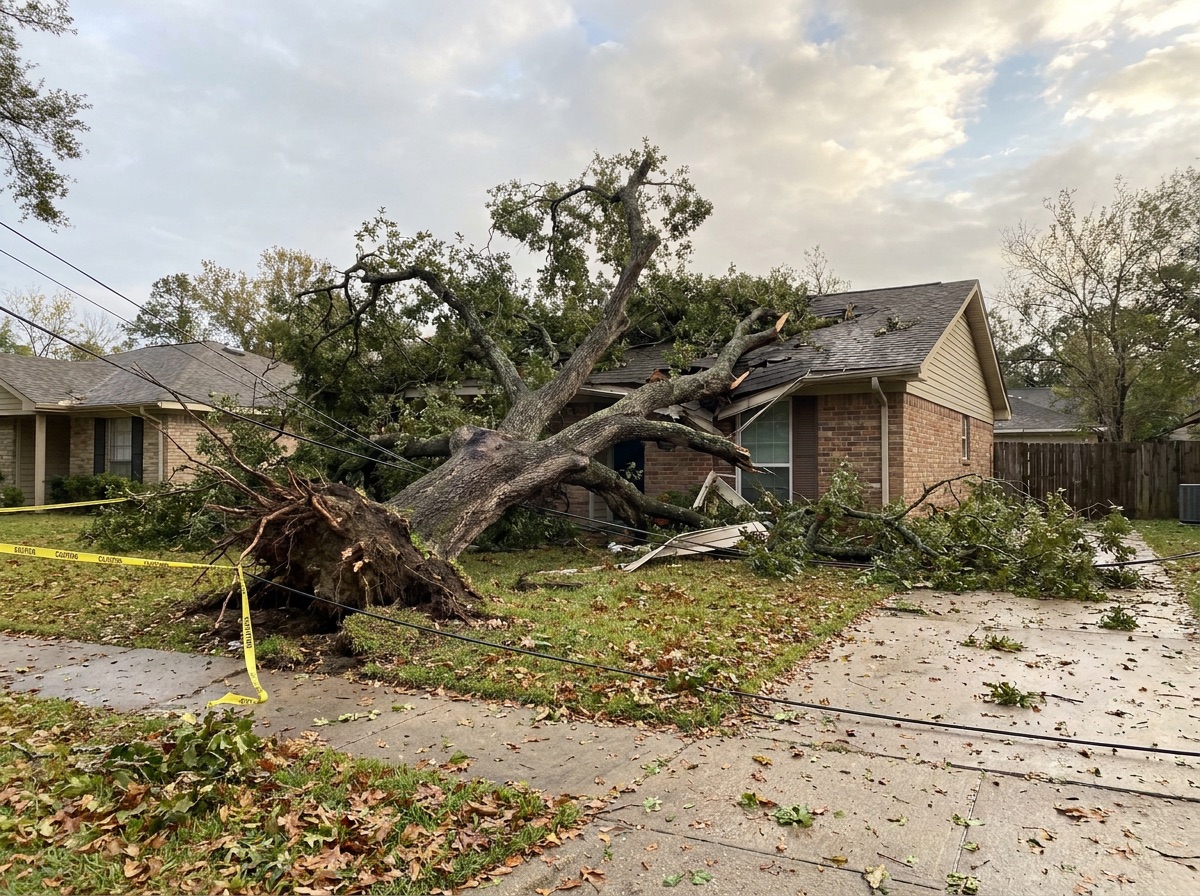
Tree Removal & Debris in Miami
A fallen tree on your home or blocking access is a safety emergency. Storm Damage 911 connects you with local tree-removal crews who safely remove downed and hazardous trees and haul away storm debris, often the same day.
Tree Removal in Miami
Free, no obligation. We match you with up to two licensed, insured local pros so you can compare.
- Licensed pros
- Free, no spam
- One call, not eight
Got it. You are in good hands.
A vetted local pro will reach out shortly. For an active emergency, call us now at (813) 555-0911.
Tree Removal after storms in Miami
Miami-Dade County sits at roughly 6 feet above sea level on a low-lying limestone peninsula flanked by the Atlantic Ocean to the east and Biscayne Bay running through its core, making storm surge the primary life-safety threat: a direct Category 1 hurricane can push 1.5 feet or more of seawater into Zone A communities on barrier islands like Miami Beach, Key Biscayne, and Sunny Isles Beach, while a major Category 3-5 storm can drive surge several miles inland through the county's dense canal network. The county sits in a High Velocity Hurricane Zone (HVHZ), the highest wind-exposure classification in the continental United States, with design wind speeds of 170-200+ mph driving the most stringent building code in the country - a direct legacy of Hurricane Andrew (1992), which struck south Miami-Dade near Homestead and Kendall as a Category 5, causing over $25 billion in damage and remaining the benchmark event for regional construction standards. Hurricane Irma (2017) demonstrated the Bay-side surge threat specifically: 3-5 feet of inundation along the Biscayne Bay shoreline from Homestead to Brickell, with isolated peaks above 6 feet in Coconut Grove, while agricultural South Miami-Dade lost 50% of its crops. Inland flooding from the county's flat topography, porous limestone substrate, and extensive canal system compounds wind and surge damage: heavy rainfall from any slow-moving tropical system can inundate neighborhoods well outside coastal surge zones, and rising baseline sea levels (projected 10-17 inches above 2000 levels by 2040) are steadily reducing drainage margins countywide.
That is why matching with a pro who actually works in Miami-Dade County matters. The tree removal specialists in our Miami network are licensed for this trade, insured, and locally rated, and they give you a free, written assessment with no obligation.
When a storm drops a tree onto a house, garage, or fence line, the job is no longer simple tree work - it is a controlled structural extraction requiring rigging systems, engineered lowering, and precise coordination to avoid worsening damage to the building below. Emergency tree removal from structures involves an ISA-trained arborist assessing the load path and failure risk, a rigged dismantling sequence that cuts the tree in sections and lowers each piece by rope or crane rather than dropping it free, and final debris processing that clears the site for repair contractors. In Florida, hurricane seasons generate concentrated demand and prices spike 25-30% during post-storm surges. In Illinois, ice storms and straight-line winds are the primary drivers of structural tree failures. Both states rely on ISA Certified Arborists as the de facto professional credential, though neither has mandatory statewide arborist licensing. Costs range from roughly $500 for a small fallen limb to over $7,000 for a large oak on a roof requiring crane rigging.
The processHow tree removal & debris in Miami works, step by step
- Site hazard assessmentA certified arborist evaluates the tree's weight distribution, the structural integrity of what it is resting on, proximity to utilities, and ground conditions for equipment access before any cuts are made. This assessment determines whether the job requires a climber-rigging approach, a crane, or a bucket truck.
- Establish work zones and protect the structureThe crew secures the work perimeter, tarps or boards exposed roof penetrations to prevent additional water intrusion, and positions ground workers and equipment. Utilities (overhead lines) are identified and the power company notified if contact or proximity is an issue.
- Rig the tree before cuttingThe lead climber ascends and installs a block-and-tackle or redirected rope system using pulleys anchored at load-bearing points in the tree. This rigging controls the descent of every cut section so it is lowered - not dropped - away from the structure. For large or crane jobs, rigging lines are attached to a crane hook instead.
- Sectional dismantling from top downThe arborist works top to bottom, cutting the crown into manageable sections. Each section is rigged, cut, and lowered by a ground crew member controlling tension on the line. This is the critical phase for structure protection - a free-fall section can add hundreds or thousands of pounds of impact to a compromised roof.
- Remove trunk from the structureOnce the crown is cleared, the trunk - which is often the heaviest single load still resting on the building - is cut into short rounds or planks and either rigged down piece by piece or removed by crane lift. Care is taken not to drag sections across roofing material.
- Debris processing and haul-offAll wood, bark, and leaf debris is chipped, hauled, or stacked per the homeowner's preference and local disposal regulations. Stump grinding is quoted separately. The crew clears the site so roofing and structural repair contractors can begin work immediately.
- Damage documentationBefore leaving, the crew photographs or videos the damage extent, the removal process, and the cleared area. This documentation supports the homeowner's insurance claim and establishes scope for repair contractors.
Cost factors
- Tree size and height. Small trees under 30 feet: $285-$435. Medium trees 30-60 feet: $600-$1,200. Large trees over 80 feet: $1,160-$2,000+. Height drives both time and rigging complexity.
- Structural contact and roof involvement. A tree resting on or through a structure adds 25-50% to the base removal cost because every cut requires controlled lowering rather than directional felling. Sectional dismantling from a structure takes 3-4 times longer than open-ground removal.
- Crane or bucket truck requirement. Crane rental adds $500-$1,500 per day to the job; total crane jobs often run $3,000-$7,000 depending on tree size. Bucket trucks add $250-$600. Required when climber access is blocked or unsafe, or when the tree mass is too large to rig by hand.
- Emergency and after-hours timing. Emergency dispatch (same-day or overnight) adds 30-100% to the base price. Post-storm surge pricing - common in Florida after hurricanes - can add another 25-30% as crews work at capacity across large service areas.
- Tree species and wood density. Dense hardwoods like live oak or Florida slash pine produce heavier sections, slow cutting, and dull chains faster, increasing labor time and disposal volume compared to softer species.
- Access and site conditions. Fenced yards, slopes, tight suburban lots, or soft ground that prevents heavy equipment from approaching the tree increase rigging complexity and hand-labor time. Each obstacle can add $200-$800.
- Debris disposal and stump grinding. Haul-off of chips and wood runs $50-$150 per load. Stump grinding is typically quoted separately at $150-$450 per stump depending on diameter. Some crews include one haul in their quote; confirm in writing.
- Number of trees and scope. Multiple trees from a single storm event are often quoted at a per-tree discount once equipment and crew are already mobilized. A second tree on the same property may cost 20-40% less than the first.
When to call a pro
- A tree or large limb is visibly resting on or embedded in a roof, wall, deck, or fence after a storm
- A tree has been uprooted or the root ball has heaved, and the trunk is leaning against the structure
- Interior ceiling sagging, active water intrusion, or cracking sounds coming from the structure after a tree impact
- A split or partially broken limb ('widow maker') remains suspended in the canopy above a structure or occupied area, held only by bark or adjacent branches
- A tree is making contact with overhead power lines following storm damage - requires immediate utility notification before tree work begins
- Visible root damage, soil heaving, or a trunk lean that has worsened after high winds, indicating imminent failure risk
- The tree is dead, severely diseased, or structurally compromised in a way that makes it a clear fall hazard to a structure during the next wind event
How insurance typically works
This information is educational only and is not insurance or legal advice. Whether to file a claim is a decision for the homeowner and their insurer or a licensed public adjuster. Standard homeowners insurance (HO-3) typically covers tree removal and structural repair when a tree falls on a covered structure - such as a house, garage, attached fence, or shed - as a result of a covered peril like windstorm, hail, or lightning. If the tree falls and causes no structural damage, most policies do not cover removal; a limited exception exists for trees blocking a driveway or handicap-accessible ramp, usually capped at $500-$1,000. Debris removal coverage under standard HO-3 policies is typically sub-limited to $500 per tree and $1,000 per occurrence. These caps are often far below actual removal costs for large trees, leaving a gap the homeowner pays out of pocket after meeting the deductible. In Florida, policies triggered by a named hurricane or tropical storm are subject to a separate hurricane deductible - commonly 2% to 5% of the dwelling's insured value - rather than the standard all-perils deductible. On a $400,000 home, a 2% hurricane deductible means the homeowner owes $8,000 before coverage applies. The homeowner is responsible for paying their deductible. It is illegal under Florida law (and the law of virtually every state, including Illinois) for a contractor to waive, absorb, or discount the deductible as part of a service agreement. Agreeing to such an arrangement, or misrepresenting damage on an insurance claim to increase a payout, constitutes insurance fraud and carries criminal penalties for both the homeowner and the contractor. Review your policy terms and contact your insurer directly to understand your specific coverage.
How to choose the right pro
- Verify ISA Certified Arborist credential - check the active credential against the ISA's public verification tool at isa-arbor.com. In Florida, also ask whether the company holds any applicable DBPR or county-level contractor license relevant to their scope of work.
- Confirm the company carries a minimum of $1 million general liability insurance AND workers' compensation coverage. Request certificates of insurance naming you as a certificate holder before work begins. Tree work is high-risk; an uninsured injury on your property can result in a lien or lawsuit.
- Ask specifically who will be on site and doing the climbing. Some companies subcontract storm work to unlicensed day laborers during surge periods. The person performing the aerial rigging should be the credentialed arborist.
- Request a written scope of work that specifies what is included: rigging approach, debris disposal, stump handling, haul-off loads, and cleanup standard. Verbal agreements on storm jobs frequently lead to disputes over what was supposed to be removed.
- For large trees or crane jobs, ask for a pre-work site walk and a written rigging plan. Any company unwilling to explain their removal sequence before starting is a red flag for structure-adjacent work.
- Check online reviews specifically for storm-damage and roof-contact jobs, not general tree trimming. Emergency response quality, communication, and whether they properly protected the structure are the relevant data points.
- Ask whether they will provide documentation (photos and written scope) suitable for your insurance claim before they begin work. Reputable companies doing storm work include this as standard practice.
- For Florida jobs during or after a named storm: confirm the company is registered in Florida (not an out-of-state 'storm chaser' operating without proper licensure) and verify their physical business address is local or regional.
What is warrantied
Professional tree removal companies typically provide a workmanship warranty covering the removal process itself - meaning that if debris is left, or if rigging caused damage to the structure beyond the original tree impact, they will return to correct it. This warranty is informal in most cases and typically runs 30-90 days post-job. There is no warranty on the tree itself (trees are natural objects, not installed products). Stump grinding may carry a separate warranty that the stump is ground to a specified depth below grade, usually 6-12 inches. Damage to the structure caused by the tree fall is covered under your homeowners insurance policy, not by any contractor warranty - the tree service is responsible only for the damage their crew causes during removal. Always get the workmanship warranty in writing as part of the contract, specifying what it covers and for how long.
Avoid theseCommon mistakes
- Hiring based solely on lowest price during or immediately after a storm - post-storm surge brings out unlicensed, uninsured operators who may cause further structural damage or disappear before the job is complete
- Allowing work to begin before the crew provides proof of liability insurance and workers' compensation - verbal assurances are worthless if a worker is injured on your property
- Removing or disposing of debris before an insurance adjuster can inspect the damage - most policies require the damage to be documented in place before repairs begin; clear the minimum necessary for safety and photograph everything else
- Signing a contract that includes a clause stating the contractor will work directly with your insurance company or that your deductible will be 'covered' - this arrangement is a fraud red flag in both Florida and Illinois
- Failing to ask whether the quote includes haul-off and debris disposal - many base quotes cover cutting only, and the homeowner is left with a yard full of wood to deal with separately
- Attempting DIY limb or trunk removal from a structure without rigging knowledge - cutting a load-bearing section incorrectly can cause a sudden shift in weight that collapses the section of roof the tree is resting on
Tree Removal in Miami: questions
Do you cover Miami and nearby areas?
Yes. We match tree removal requests across Miami and all of Miami-Dade County. The pro we connect you with is local and licensed to work in your area.
How fast can a tree removal pro reach me in Miami?
Because tree removal is time-sensitive, our Miami network crews prioritize it, typically the same day or next day after a storm.
Does homeowners insurance cover tree removal if a tree falls on my house?
Generally yes, when a tree falls on a covered structure as a result of a covered peril - windstorm, hail, or lightning are the most common. The insurer typically covers both the structural repairs and the cost to remove the tree from the structure. However, most standard HO-3 policies cap the debris removal portion at $500 per tree and $1,000 per occurrence. If your actual removal cost exceeds those limits, you pay the difference. Read your specific policy - limits vary by carrier and endorsement.
What if the tree falls in my yard but doesn't hit anything?
Most standard homeowners policies do not cover removal of a tree that falls harmlessly in the yard without damaging a covered structure. Some policies include a small sub-limit ($500-$1,000) for trees blocking a driveway or handicap ramp. Otherwise, yard-only tree debris removal is an out-of-pocket expense.
In Florida, is tree removal covered differently because of hurricane deductibles?
Yes. When the cause of loss is a named hurricane or tropical storm, Florida insurers apply a separate hurricane deductible - typically 2% to 5% of your home's insured dwelling value - instead of the standard all-perils deductible (often $1,000-$2,500). On a $300,000 insured home with a 2% hurricane deductible, you owe $6,000 before the policy pays anything. This is a significant financial exposure in storm-heavy areas of Florida.
Do I need a licensed arborist for tree removal in Florida or Illinois?
Neither Florida nor Illinois has a mandatory statewide arborist license. In Florida, tree contractors generally operate under DBPR contractor licensing for relevant scopes, and many county-level certificates of competency were phased out in 2025 under HB 735. Some Florida municipalities (Miami-Dade, Orange County) require ISA Certified Arborists for work on protected tree species. In Illinois, statewide arborist licensing was repealed in 1983; Chicago requires Bureau of Forestry permits for tree work. In both states, the ISA Certified Arborist credential is the recognized professional standard - hire credentialed arborists and verify their credential is active.
How much does it cost to remove a large tree from a roof?
A large tree (over 60 feet, heavy crown) on a roof is one of the most complex and expensive removal scenarios. Expect $2,500-$7,000 or more depending on trunk diameter, wood density, crane requirement, and access. If crane rigging is needed, crane rental alone adds $500-$1,500 to the day's cost. Emergency dispatch after a storm adds another 30-100%. Most structural tree-on-roof jobs fall between $1,500 and $4,500 in practice.
What is rigging and why does it matter for structure-adjacent tree removal?
Rigging is a system of ropes, pulleys, and friction devices that allows a climber-arborist to control the descent of cut tree sections, lowering them to the ground in a controlled arc rather than allowing them to fall freely. When a tree is on or near a structure, free-falling sections are not an option - an uncontrolled drop can add hundreds of pounds of impact to a roof that is already compromised. Proper rigging is what separates a professional structural removal from a dangerous improvised one.
How soon does a fallen tree on a house need to be removed?
Immediately, as a practical matter. A tree resting on a roof creates a continuing structural load, and rain will enter any penetration within hours of the impact. Water damage compounds quickly - sheathing, insulation, drywall, and framing can sustain significant secondary damage within 24-48 hours of an opening. Call an emergency tree service first to secure and remove the tree, then a roofing contractor to close the opening.
Can I remove a tree from my roof myself?
Not safely if the tree is large, in contact with the structure, or if you lack professional rigging equipment. Cutting a load-bearing section of a tree incorrectly can suddenly shift the weight distribution and cause a roof section to collapse or the tree to drop in an unintended direction. Clearing small branches or limbs from an accessible ground-level position is within most homeowners' ability; anything requiring climbing, chainsaw work on a compromised structure, or rigged lowering is professional work.
Will my insurance pay for tree removal if my neighbor's tree fell on my house?
Yes, in most cases your own homeowners insurance covers the damage and removal costs regardless of whose tree it was, assuming the cause was a covered peril. Negligence claims against a neighbor (for example, if they had been notified of a dead or hazardous tree and failed to act) are a civil matter separate from your insurance claim and are difficult to prove. Your insurer may pursue subrogation against your neighbor's liability policy if negligence is established, but that is handled insurer to insurer.
What documents should I get from a tree removal company before they start storm work?
At minimum: a certificate of general liability insurance (minimum $1 million) naming you as a certificate holder; proof of workers' compensation coverage; a written scope of work specifying what is included in the quoted price (removal, rigging approach, stump grinding, debris haul-off, number of loads); and a signed contract. During post-storm periods, fraudulent contractors operate at high volume - getting everything in writing before work starts is essential.
Is stump grinding included in tree removal quotes?
Rarely by default. Most tree removal quotes, including emergency structural removals, cover the tree above grade and debris processing but price stump grinding separately. Stump grinding typically runs $150-$450 per stump depending on stump diameter and root spread. Ask for a line-item stump quote when requesting the removal estimate.
What happens to the wood after the tree is removed?
Standard practice is to chip branches and smaller wood for haul-off, and to cut trunk sections into manageable rounds. Haul-off of chipped material typically runs $50-$150 per load. Some homeowners opt to keep the wood rounds for firewood. Clarify disposal expectations in your written scope - 'debris removal' means different things to different contractors.
Does the tree removal company repair the roof after removing the tree?
Generally no. Tree services remove the tree; structural repair is a separate scope handled by a licensed roofing contractor or general contractor. A good emergency tree company will tarp and board open roof areas after removal to prevent water intrusion until permanent repairs can be made - ask whether this is included in the quote. The structural repair is what your insurance dwelling coverage applies to.
How do I find a reputable emergency tree service after a storm in Florida or Illinois?
Start with ISA's 'Find an Arborist' tool at isa-arbor.com, which verifies active credentials and geographic coverage. Check the Tree Care Industry Association (TCIA) member directory. Avoid door-to-door contractors offering unsolicited post-storm work - these are frequently storm chasers operating without proper licensing or insurance. Ask neighbors for local companies they have used previously. Verify the company has a physical local address and an established review history before signing anything.
What is the difference between a tree service and an arborist?
A tree service is a company. An arborist is a trained and credentialed professional - specifically, an ISA Certified Arborist has passed a competency examination covering tree biology, pruning, rigging, hazard assessment, and safety, and must recertify every three years. Not all tree service companies employ ISA Certified Arborists. For structure-adjacent emergency removal and hazard assessments, specifically ask whether an ISA Certified Arborist will be on-site directing the work, not just a general labor crew.