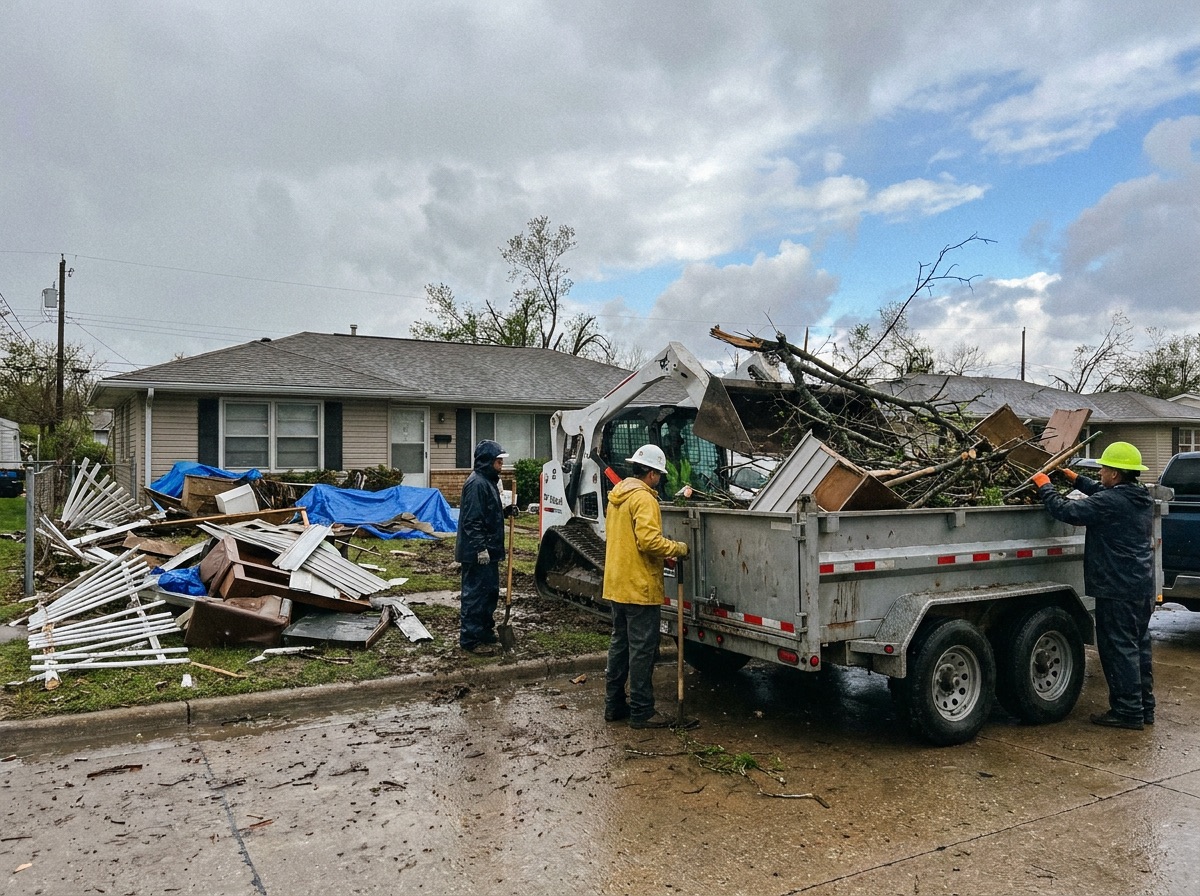
Storm Debris Cleanup in Palm City
After a storm, debris is a safety hazard and slows every other repair. Storm Damage 911 connects you with local crews who clear and haul storm debris so the rest of your restoration can move.
Debris Cleanup in Palm City
Free, no obligation. We match you with up to two licensed, insured local pros so you can compare.
- Licensed pros
- Free, no spam
- One call, not eight
Got it. You are in good hands.
A vetted local pro will reach out shortly. For an active emergency, call us now at (813) 555-0911.
Debris Cleanup after storms in Palm City
Martin County sits on Florida's Treasure Coast with Atlantic-facing barrier islands on Hutchinson Island and the St. Lucie Inlet, making it directly vulnerable to hurricane storm surge - the greatest recorded life-safety threat in the county. The barrier island communities face surge inundation estimates up to 6 feet in the highest-risk coastal evacuation zones, with some inland low-lying zones rated for up to 13-16 feet under major storm scenarios. The county suffered back-to-back direct landfalls from Category 2 Hurricane Frances and Category 3 Hurricane Jeanne in September 2004, both striking near the Stuart/Hutchinson Island coastline within three weeks of each other and triggering major federal flood-map revisions for the region. Hurricane Irma in 2017 produced wind gusts near 100 mph on Hutchinson Island, downed 95 power lines, and caused significant inland flooding that closed 17 roads; properties away from the coast also face flooding risk from the South Fork of the St. Lucie River and nearby drainage basins during and after tropical events.
That is why matching with a pro who actually works in Martin County matters. The debris cleanup specialists in our Palm City network are licensed for this trade, insured, and locally rated, and they give you a free, written assessment with no obligation.
After a hurricane, tornado, severe thunderstorm, or ice storm, the property damage that is visible above ground - fallen trees, collapsed fencing, scattered roofing materials, destroyed outbuildings, and water-soaked household contents - must be identified, sorted, hauled, and disposed of correctly before restoration work can begin. Storm debris cleanup is the industry term for that complete cycle: site hazard assessment, debris segregation by material type, mechanical or manual loading, transport, and lawful disposal or recycling at a permitted facility. In Florida, where hurricane season runs June through November, this service is in intense demand within hours of landfall. In Illinois, severe spring and summer thunderstorms, derechos, and winter ice loading create comparable need, typically without the volume surge Florida sees after named storms. A professional crew brings the equipment - skid steers, dump trucks, chippers, and hand tools - to clear what homeowners cannot safely or legally handle themselves, and to do it in sequence with the insurance documentation process.
The processHow storm debris cleanup in Palm City works, step by step
- Safety assessment and hazard identificationBefore any debris is touched, the crew walks the property to identify active electrical hazards (downed or low-hanging lines), gas leaks, structural instability, and standing water. Work does not begin until utilities are confirmed safe or the utility company has been notified. This step is non-negotiable; many storm injuries happen to people who skip it.
- Photo and video documentationThe crew or the homeowner (ideally both) documents the full property in its post-storm state - wide shots, close-ups of each damage zone, material types, and approximate volumes. This record supports insurance claims and establishes the scope before removal alters the site. Do not remove anything until documentation is complete unless an immediate safety threat requires it.
- Debris segregation by material typeProfessional crews sort debris into categories on-site: vegetative (branches, stumps, leaf litter), construction and demolition materials (shingles, lumber, drywall, insulation), metals (gutters, fence posts, appliances), household contents (furniture, textiles, electronics), and hazardous materials (asbestos-containing roof tile, lead paint chips, chemicals, batteries). Mixing categories increases disposal cost and can violate landfill acceptance rules.
- Mechanical and manual debris removalLarge items - fallen trees, roof sections, collapsed structures - are cut or broken down with chainsaws, reciprocating saws, skid steers, or track loaders. Hand crews follow to collect smaller material. Root balls from uprooted trees require equipment with sufficient lift capacity; attempting removal with a pickup and chain causes vehicle and property damage.
- Loading and transportSorted debris is loaded into dump trucks, hook-lift containers, or roll-off dumpsters appropriate to the volume. Vegetative debris typically goes to a mulching or composting facility; construction debris goes to a licensed C&D landfill or transfer station; metals go to scrap processors; hazardous materials require a licensed hazardous waste hauler. Illinois requires debris to go to a permitted CCDD (Clean Construction and Demolition Debris) or GCDD facility under IEPA regulations.
- Site clearing and final sweepAfter bulk removal, crews rake, blow, or vacuum the site to collect nails, shingle granules, glass shards, and small fragments that cause tire punctures and injuries. Driveways and access paths are checked for embedded fasteners. For lots with significant soil disturbance, a final grade may be required to restore drainage patterns.
- Disposal documentation and weight ticketsReputable haulers provide weight tickets or load manifests from the disposal facility. These records matter for insurance reimbursement, FEMA Public Assistance claims (for qualifying events), and verification that debris was disposed of lawfully - not dumped illegally. Request copies before final payment.
Cost factors
- Volume and weight of debris. The primary pricing driver. Light vegetative debris (branches, leaves) runs $75-$150 per cubic yard or $200-$500 per truckload. Mixed construction debris (shingles, lumber, drywall) runs $70-$150 per cubic yard. Concrete, brick, and masonry are often priced by the ton due to high landfill tipping fees, typically $80-$150 per ton including haul. A single large oak tree can fill 2-4 dump truck loads.
- Type of debris and disposal fees. Vegetative debris costs least to dispose of because it can go to mulching facilities. Construction and demolition debris carries higher tipping fees at C&D landfills. Hazardous materials (asbestos roof tile, lead paint, treated wood, propane tanks, refrigerants) require licensed specialty disposal and add $300-$1,500+ to the job depending on quantity and type.
- Site access and working conditions. Narrow driveways, fences, pools, buried utilities, or soft ground that cannot support heavy equipment require smaller machinery or hand work, which is slower and more expensive. Post-storm flooding or standing water on the property adds crew risk and equipment cost.
- Post-storm demand surge. After a named storm or major weather event, labor and equipment costs in the affected area typically rise 20%-50% as local capacity is overwhelmed. Crews traveling from outside the region charge mobilization fees. In Florida after a major hurricane, crews from Georgia, the Carolinas, and Texas flood the market - verify their licensing before hiring.
- Structural vs. vegetative debris mix. A yard full of tree branches and leaf debris is among the cheapest to clear. A property with collapsed outbuildings, sections of roofing, ruined fencing, and storm-damaged contents involves multiple material streams, longer on-site time, and higher equipment costs. Expect $800-$2,500 for mid-complexity mixed jobs and $3,000-$10,000+ for properties with structural collapse elements.
- Lot size and debris spread. A quarter-acre suburban lot with contained debris is a different scope than a half-acre property where wind scattered materials across multiple neighboring parcels. Each linear foot of fence line, each outbuilding, and each additional structure adds time. Crews typically quote by walk-through estimate, not hourly rate, for storm work.
- Labor rates by region. South Florida (Miami-Dade, Broward, Palm Beach) and metro Chicago carry higher labor rates than rural central Florida or downstate Illinois. Base crew rates range from $50-$120 per labor hour depending on region and post-storm demand level.
Your options
- Roll-off dumpster rental (self-service). For homeowners or contractors doing their own debris loading, renting a 10-30 cubic yard roll-off dumpster runs $300-$600 for a standard 7-day rental plus disposal fees. Useful when cleanup will be done in phases or when homeowner wants to control the pace. Does not include any labor.
- Full-service haul-away crew. A crew provides labor, truck, and disposal in one quoted price. Best for post-storm work when speed, safety expertise, and proper material segregation are required. Most storm debris jobs use this model.
- Debris grinding and chip-out (vegetative only). Tree debris, branches, and stumps can be ground into mulch on-site, reducing haul volume and cost. The resulting mulch can often stay on the property as ground cover. This option only works for clean vegetative debris with no mixed construction materials.
- FEMA-eligible curbside debris collection (post-declared disaster). Following a federal disaster declaration, many Florida and Illinois municipalities organize curbside debris pickup at no cost to homeowners for properly sorted and staged debris. Debris must be placed at the curb in separated piles (vegetative separate from construction materials). Not guaranteed and available only in declared disaster zones - verify with your county solid waste authority.
When to call a pro
- One or more trees have fallen on or adjacent to the structure, fence line, driveway, or utility lines
- Sections of roofing, soffit, fascia, siding, or gutters have separated and landed on the property
- Outbuildings such as sheds, carports, or screen enclosures have partially or fully collapsed and debris is scattered across the lot
- Standing water is present and debris is blocking drainage paths or downspouts, increasing flood and mold risk
- Driveways or pedestrian paths are blocked by limbs or structural materials, preventing access for vehicles or emergency services
- Neighboring debris has blown onto the property and cannot be returned without equipment
- The volume or weight of debris on the property exceeds what can be safely handled with consumer tools and a standard pickup truck
- Debris contains suspected hazardous materials - older roofing tile (potential asbestos), painted wood from pre-1978 structures, broken refrigerators or propane tanks - requiring professional handling
How insurance typically works
This information is educational only and does not constitute insurance, legal, or claim advice. Homeowners insurance policies commonly include a debris removal provision, but coverage is not automatic or unlimited. Debris removal is typically covered only when tied to physical damage to a covered structure - a tree that falls and damages your roof may generate a covered debris removal claim, while a tree that falls in the yard without hitting anything is frequently excluded. Most standard policies cap debris removal reimbursement at approximately 25% of the covered property damage claim amount, though additional endorsements of up to $10,000 may be available at higher premiums. In Florida, windstorm and named-storm deductibles are typically calculated as a percentage of the home's insured value - commonly 2% to 5% - not as a flat dollar amount. On a home insured for $300,000, a 2% deductible is $6,000; a 5% deductible is $15,000. The homeowner is fully responsible for paying their deductible before insurance coverage applies. Waiving a deductible, accepting work without paying it, or misrepresenting damage to an insurer constitutes insurance fraud under Florida Statute §817.234 and Illinois law, and is a criminal offense. Document all damage with dated photos and video before any debris is removed. Retain all paid invoices and disposal weight tickets. Your insurer will require this documentation to process a debris removal claim.
How to choose the right pro
- Verify current liability insurance - minimum $1,000,000 general liability - and ask for a certificate naming you as an additional insured for the duration of the job
- In Florida, confirm whether the scope involves structural demolition; if so, verify the contractor holds a current Certified General Contractor or Demolition Contractor license through the Florida DBPR at myfloridalicense.com
- In Illinois, check whether your municipality (Chicago, Cook County, Naperville, Evanston, etc.) requires a local general contractor or demolition registration, and verify the contractor holds it - licensing is municipal, not statewide for most trades
- Ask explicitly how debris will be disposed of and request a copy of the disposal facility's permit number; illegal dumping can result in fines traced back to the property owner in some jurisdictions
- Require a written itemized estimate before work begins that specifies scope, material types to be removed, disposal method, and total price - verbal quotes are unenforceable and frequently balloon after storm events
- Be cautious of out-of-state contractors who arrive door-to-door immediately after a storm; verify they have a verifiable local address, current insurance, and required municipal registration before signing anything
- Ask whether the crew has experience with insurance documentation procedures - taking before-and-after photos, staging debris for adjuster inspection, and providing weight tickets - which is standard practice for legitimate storm cleanup contractors
- Confirm that hazardous materials such as asbestos-containing roofing, treated lumber, refrigerants, and batteries will be handled separately and disposed of through a licensed hazardous waste channel, not mixed into general C&D debris
What is warrantied
Storm debris cleanup is a service, not a manufactured product installation, so the warranty structure differs from roofing or HVAC work. Most reputable contractors offer a satisfaction guarantee on workmanship - meaning they will return within 24-72 hours to collect any debris that was missed on the initial pass, at no additional charge, if reported promptly. There is no industry-standard warranty period for labor beyond this initial callback window. For jobs involving stump grinding or root removal, some contractors offer a limited guarantee (typically 30-90 days) against resprouting on ground stumps. When debris cleanup is performed as part of a broader storm restoration contract that includes structural repair, warranty terms follow the repair contractor's standard warranty, which in Florida must comply with the implied warranty of merchantability under Florida common law. Get any cleanup warranty commitment in writing before the work begins; verbal guarantees after a storm event are difficult to enforce.
Avoid theseCommon mistakes
- Removing or moving debris before documenting it - insurers and adjusters need dated photographs and video of the post-storm condition before anything is displaced; removal without documentation can result in denied or reduced claims
- Hiring an unlicensed or uninsured contractor to save money - post-storm contractor fraud is a documented pattern in both Florida and Illinois; if a worker is injured on your property and the contractor has no workers' compensation coverage, you may face liability
- Mixing hazardous materials such as asbestos roof tiles, old appliances with refrigerants, treated lumber, or chemical containers into general debris piles - this can cause illegal disposal citations, landfill rejection of the entire load, and added remediation costs
- Failing to request and retain disposal weight tickets and paid invoices - these are required for insurance reimbursement and for FEMA Public Assistance documentation in declared disaster areas; losing them forfeits recoverable costs
- Attempting to remove large uprooted trees or structural debris without appropriate equipment - consumer-grade tools and pickup trucks are inadequate for root balls and collapsed structures; improper removal causes secondary property damage and serious injury
- Signing an Assignment of Benefits (AOB) agreement with a debris removal contractor without fully understanding it - in Florida, AOBs transfer your insurance claim rights to the contractor; while now restricted under Florida's 2023 AOB reform law (SB 2A), homeowners should still read any document that references their insurance policy before signing
Debris Cleanup in Palm City: questions
Do you cover Palm City and nearby areas?
Yes. We match debris cleanup requests across Palm City and all of Martin County. The pro we connect you with is local and licensed to work in your area.
How fast can a debris cleanup pro reach me in Palm City?
Because debris cleanup is time-sensitive, our Palm City network crews prioritize it, typically the same day or next day after a storm.
How soon after a storm should I call a debris cleanup crew?
Within 24-48 hours if debris is blocking access, creating a safety hazard, or if water is standing against the structure. Mold can begin colonizing water-saturated materials within 24-48 hours in Florida's climate, and within 48-72 hours in Illinois summers. That said, do not remove or relocate anything before you have thorough photographic and video documentation of the post-storm condition - insurers need that record. The sequence should be: document first, call your insurance company to report the claim, then mobilize cleanup.
Will my homeowners insurance pay for storm debris cleanup?
Possibly, but with conditions. Most standard homeowners policies cover debris removal only when it is directly tied to physical damage to a covered structure - for example, a tree that fell and damaged your roof or fence. A tree that landed in the yard without hitting anything is commonly excluded. Coverage is typically capped at roughly 25% of the covered property damage claim amount. Florida windstorm and named-storm deductibles are percentage-based (often 2%-5% of insured home value), not flat dollar amounts, so your out-of-pocket threshold may be higher than you expect. Review your declarations page and call your insurer before authorizing removal.
What is a wind/hurricane deductible and how does it affect my cleanup claim in Florida?
Florida insurers are permitted to impose a separate windstorm or named-storm deductible calculated as a percentage of your home's insured replacement value - commonly 2%, 3%, or 5%. If your home is insured for $350,000 and your hurricane deductible is 3%, you pay the first $10,500 out of pocket before any coverage applies. This deductible applies to all storm-related damage including debris removal, not just structural repairs. The deductible is the homeowner's responsibility and cannot legally be waived by a contractor.
Does Illinois homeowners insurance cover storm debris removal?
Standard Illinois homeowners policies follow the same general framework as elsewhere - debris removal is typically covered as part of the property damage claim when it results from a covered peril (windstorm, hail, tornado). Illinois does not have the percentage-based hurricane deductibles common in Florida, so most Illinois policies carry a flat deductible. The same limitation applies: debris must be tied to structural damage to be reimbursable in most policies. After a FEMA-declared disaster, Illinois counties may also organize municipally-funded debris pickup for qualifying residential properties.
What types of debris are typically included in a storm cleanup service?
A full storm debris cleanup service covers fallen trees and limbs, uprooted stumps, destroyed fencing, collapsed outbuildings (sheds, carports, pergolas, screen enclosures), roofing materials (shingles, tiles, underlayment, gutters), siding and soffit sections, insulation and drywall from breached wall systems, damaged furniture and contents left outdoors, and scattered smaller debris like gravel, pavers, and signage. Most crews will also clear driveways, walkways, and access paths as part of the job. Hazardous materials require separate handling and are typically quoted separately.
How do I handle suspected asbestos in storm debris, such as old roof tiles?
Do not handle, break apart, or sweep older textured roof tiles or shingle-like roofing materials without knowing their composition. Asbestos-containing materials were common in Florida and Illinois homes built before the mid-1980s, including certain flat roof tiles, floor tiles, and textured drywall compounds. If your property was built before 1980 and roofing or wall materials are disturbed, contact a licensed asbestos abatement contractor for sampling before debris is moved. Mixing asbestos materials into general debris piles is illegal and can result in significant fines. A legitimate storm debris contractor will flag this possibility during their site walk.
How is storm debris priced - by the load, by the cubic yard, or by the hour?
Most residential storm debris jobs are priced with a flat estimate based on a site walk, which accounts for estimated volume, material types, crew time, equipment, and disposal fees. Some contractors use per-cubic-yard pricing ($75-$150 per yard for mixed debris) or per-truckload pricing ($200-$800 per truck depending on material weight and disposal facility fees). Hourly billing is less common for storm work but occurs on smaller jobs or when scope is genuinely unknown before arrival. Always get a written estimate with a scope description before signing; avoid open-ended hourly agreements for large post-storm jobs.
What happens to the debris after it leaves my property?
Vegetative debris (branches, stumps, leaf matter) typically goes to a mulching, composting, or green-waste facility. Clean construction and demolition debris (lumber, concrete, metal, drywall) goes to a licensed C&D landfill or transfer station. In Illinois, this means a facility permitted under the Illinois EPA's CCDD (Clean Construction or Demolition Debris) or GCDD (General Construction or Demolition Debris) program. Metals are often sold to scrap processors. Hazardous materials require a licensed hazardous waste hauler and go to an approved treatment or storage facility. Reputable contractors provide weight tickets from the disposal facility - request them.
Can a storm debris crew also remove my damaged fence, shed, or deck?
Yes, most full-service storm debris contractors handle structural debris from detached or light structures such as fencing, wood decks, screen enclosures, sheds, and carports as part of the scope. This differs from demolishing an attached structure like a damaged garage addition, which may require a building permit and a licensed general contractor or demolition contractor in both Florida and Illinois. When in doubt, ask the contractor whether they are licensed for demolition work and whether a permit is required before they start - particularly in Florida, where demolition contractor certification requires 3 years of documented experience.
How long does a typical residential storm debris cleanup take?
For a standard suburban lot (0.2-0.5 acres) with moderate post-storm debris - downed limbs, damaged fence sections, scattered roofing material - a crew of 3-4 with one truck typically completes the job in 4-8 hours. Properties with one or more large fallen trees, collapsed outbuildings, or significant structural debris can take 1-3 full days. Jobs involving equipment-intensive work such as large root ball removal or grading require additional scheduling for the equipment. After major hurricanes in Florida, lead times can stretch to 1-2 weeks due to regional demand.
What should I do with debris if I have to wait for a contractor?
Move small, non-hazardous debris that creates an immediate safety hazard - blocking exits, covering walkways - but photograph everything before moving it. Do not attempt to remove trees, structural materials, or anything that requires equipment. If a tree has partially punctured the roof or wall, tarp over the opening to prevent water intrusion, but do not remove the tree until a contractor assesses the structural situation - the tree may be providing temporary support. If a utility line is involved, call your utility company immediately and do not touch the debris near it.
Is there free debris removal available after a hurricane or tornado?
Potentially, but only under specific conditions. After a federal disaster declaration, FEMA's Public Assistance program can fund municipal debris removal operations. Many Florida counties (as seen after hurricanes Helene and Milton in 2024-2025) organized curbside debris collection passes for residential properties at no homeowner cost. Illinois counties have similar programs following declared disasters. To qualify for curbside collection, debris must typically be properly segregated (vegetative separate from construction materials, hazardous materials separately staged) and placed at the curb by a specified deadline. This is not available for every storm event - check your county's emergency management website immediately after a storm to see if a program has been activated.
What questions should I ask before hiring a storm debris crew?
Ask for proof of general liability insurance (minimum $1 million) and workers' compensation, verify their contractor registration or license for your municipality, ask how and where debris will be disposed of and request the disposal facility's name, ask whether they will provide weight tickets and before/after documentation for insurance purposes, ask whether their estimate is all-inclusive or whether disposal fees are added separately, and get everything in writing before any work begins. After a major storm, also verify the company has a verifiable local business address - out-of-state storm chasers often disappear before work quality issues surface.
What is the difference between storm debris cleanup and storm damage restoration?
Storm debris cleanup is the removal, haul-away, and disposal of post-storm material - trees, building fragments, damaged contents, scattered materials. It clears the site so that restoration work can begin. Storm damage restoration is the subsequent process of repairing and rebuilding what was damaged: re-roofing, replacing siding, repairing structural framing, addressing water damage and mold, and restoring interior finishes. These are distinct scopes often performed by different companies. Some full-service storm contractors perform both, but it is common to hire a debris removal crew first, complete insurance documentation and adjuster inspection, and then bring in a licensed general contractor for structural repairs.