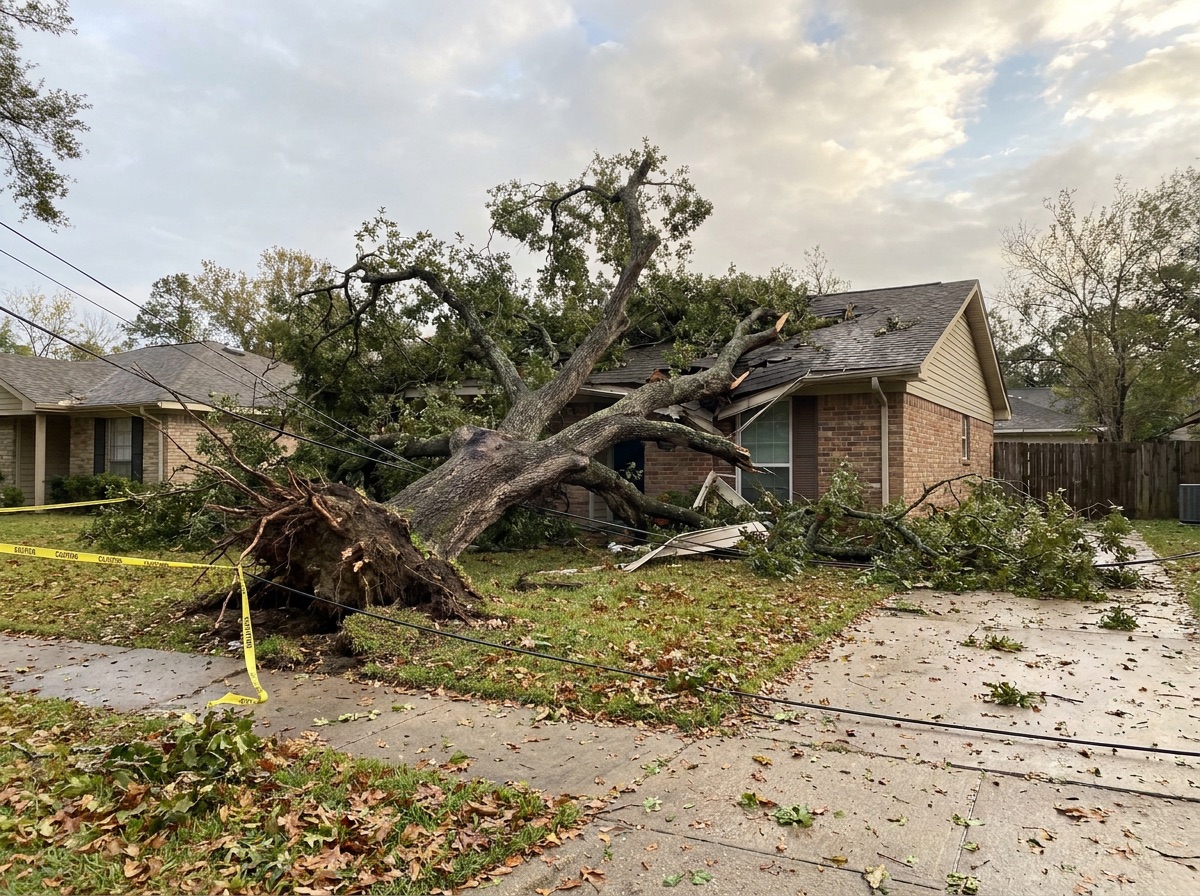
Hazardous Tree Removal
Hazardous tree removal is the planned extraction of a standing tree that has been structurally compromised by storm forces but has not yet fallen. The defining characteristic is that the tree is still technically upright but poses a credible and elevated risk of failure - through an existing lean, trunk cracking, root zone heaving, or crown splitting that will worsen with wind, rain, or continued decay.
Get matched for hazardous tree
Free, no obligation. We match you with up to two licensed, insured local pros so you can compare.
- Licensed pros
- Free, no spam
- One call, not eight
Got it. You are in good hands.
A vetted local pro will reach out shortly. For an active emergency, call us now at (813) 555-0911.
Hazardous tree removal is the planned extraction of a standing tree that has been structurally compromised by storm forces but has not yet fallen. The defining characteristic is that the tree is still technically upright but poses a credible and elevated risk of failure - through an existing lean, trunk cracking, root zone heaving, or crown splitting that will worsen with wind, rain, or continued decay. This is distinct from emergency removal (the tree has already fallen) and from routine removal (the tree is healthy but unwanted). In Florida, the post-storm window is when most hazardous trees are identified - a tree that survived three hurricanes may finally develop a basal crack or root lift after a Category 2 wind event that changes its failure probability entirely. In Illinois, derechos and ice storms load trees beyond their structural tolerances, revealing hidden trunk cavities and co-dominant stem failures that require professional assessment and planned removal before the next wind event.
When you need itSigns you need this service
- The tree has developed a visible lean that was not present before the storm, or an existing lean has noticeably increased
- A large crack or split is visible in the trunk, main scaffold limb, or at a co-dominant stem union
- The root zone shows heaving, cracking soil, or a lifted root flare on the windward side, indicating partial uprooting
- The canopy shows significant dieback or asymmetry consistent with root loss or vascular disruption caused by storm stress
- A large dead limb or dead top (also called a spike-top) is present in a tree over a structure, parking area, or frequently used outdoor space
- A certified arborist, insurance adjuster, or building inspector has identified the tree as a hazard in a written assessment
How it works
- Hazard assessment and risk ratingA certified arborist evaluates the tree using a structured assessment - examining the target (what the tree would hit if it failed), the likelihood of failure (structural defects, root condition, lean angle, species failure tendencies), and the consequence of impact. This assessment justifies the removal and provides documentation for insurance purposes. Trees leaning more than 15 degrees from vertical are typically rated as high-risk without additional defects.
- Removal plan developmentUnlike a healthy tree that can often be felled as a unit, a hazardous tree cannot be climbed in the conventional sense - internal decay, cracked stems, or an unstable root plate may mean the tree cannot safely support a climber's weight or anchor. The crew develops a plan specifying whether to use an aerial lift, crane, or ground-based rigging, and identifies the removal sequence to prevent uncontrolled movement of compromised sections.
- Equipment staging and zone controlA hazardous tree removal typically requires more exclusion zone than a standard removal - the unstable condition means the crew must account for unexpected movement. Vehicles, structures, and non-crew personnel are moved out of the potential fall zone before work begins. Cranes are used more frequently for hazardous removals than for standard ones because direct climbing is unsafe.
- Controlled sectional removalThe tree is removed in sections, top-down, with rigging controlling each piece's descent. For trees with basal cracks or root plate issues, the lower trunk sections carry the highest unpredictability and are addressed last and with the most equipment control. The root plate is assessed after the trunk is clear - a partially heaved root plate will be addressed or left to decay depending on site conditions.
- Stump cut and site stabilizationThe stump is cut as close to grade as conditions allow. If the root plate has heaved, the area is backfilled to address the depression and reduce trip hazard. Stump grinding is typically scheduled as a separate follow-up, though some companies will complete it on the same visit if the equipment is on-site.
- Documentation and written assessmentThe arborist or crew lead documents the hazard conditions observed, the work performed, and the post-removal site condition. This documentation is useful for insurance claims, property sale disclosure requirements, and neighborhood notification if the tree was near a property line.
What it costs
Hazardous tree removal costs $500 to $3,000 for most residential trees, with large specimens or those requiring crane involvement exceeding $3,000. Florida coastal pricing tends toward the higher end of the range ($650-$1,500 for a single tree), while Illinois Midwest pricing generally runs lower ($350-$730 for comparable trees). The two largest cost multipliers are structural proximity - a tree leaning over a roof or near a utility line typically adds 50-100% to the base removal cost - and the degree of structural compromise, which determines whether the tree can be climbed conventionally or requires a crane.
Hazardous Tree questions
How do I know if a tree is genuinely hazardous versus just looking bad after a storm?
The clearest indicators are structural, not cosmetic. A tree that lost most of its leaves in a storm but has an intact trunk, sound root plate, and no visible cracks is stressed but not necessarily hazardous. The hazard markers are: a new or worsening lean, visible trunk cracks (especially those that go deep when probed), root plate heaving or soil cracking at the base, hollow sections in the trunk (tapping the bark produces a hollow sound), and co-dominant stem unions with included bark that have begun to separate. When in doubt, a consulting arborist can perform a documented hazard assessment - this typically costs $100-$300 and is money well spent before removal.
Can a hazardous tree be saved instead of removed?
Sometimes. Options include cabling and bracing (installing steel cables in the crown to redistribute load away from a compromised co-dominant stem), crown reduction (removing weight from the side that creates loading on a defect), or targeted pruning of a dead top or large dead limb while leaving the living tree intact. However, these interventions are only appropriate when the structural defect is specific and addressable and when the tree has genuine value (size, species, location) that justifies the ongoing management cost. A basal crack, severe lean, or advanced decay throughout the trunk are generally not correctable by cabling or pruning.
What is the difference between a hazardous tree removal and an emergency tree removal?
Emergency tree removal is reactive - the tree has already fallen or is in immediate active contact with a structure or utility. Hazardous tree removal is proactive - the tree is still standing but has been assessed as having an elevated failure risk. Hazardous removal is typically schedulable within days to a week, rather than requiring a same-day crew. It commands a complexity premium over standard removal but is generally less expensive than a true emergency call because the crew can plan the approach in advance.
Does homeowner's insurance cover hazardous tree removal before it falls?
Standard homeowner's policies generally do not cover elective tree removal - including hazardous tree removal - unless the tree has already caused covered damage. Some policies include a limited hazardous tree provision, and some high-value property policies have broader tree coverage. Check your declarations and endorsements. The practical value of removing a hazardous tree before it falls is that you control the removal cost and avoid the much larger cost of structural repair if it fails onto the house. This is general educational guidance, not policy interpretation advice.
What does a co-dominant stem failure look like and why is it dangerous?
A co-dominant stem is when a tree produces two or more main trunks growing upward from the same union point rather than a single dominant trunk. The structural weak point is the included bark - bark tissue that gets folded into the union as both stems grow, creating a wedge with little mechanical holding strength compared to properly attached wood. After storm loading, these unions can crack, producing a visible split that opens slightly with wind. Once cracked, the holding capacity declines rapidly, and the stem can detach without warning at any size. Co-dominant stems over structures are one of the most common sources of catastrophic tree failure in residential neighborhoods.
How do I find a qualified arborist to assess a potentially hazardous tree in Florida or Illinois?
The International Society of Arboriculture (ISA) maintains a searchable database of ISA Certified Arborists at treesaregood.org. Certification requires passing an exam and maintaining continuing education - it is a meaningful credential. In Florida, the Florida Chapter of the ISA also maintains a board-certified master arborist list. In Illinois, seek ISA credentials plus Illinois Certified Arborist designation where available. For a formal written hazard assessment with documented findings, request a Tree Risk Assessment Qualification (TRAQ) certified arborist - TRAQ is the ISA's specific credential for formal risk assessment.
Can I be held liable if my hazardous tree falls and damages a neighbor's property?
In both Florida and Illinois, property owners can face liability for tree damage to neighboring property when they had prior knowledge of the hazard and failed to act within a reasonable time. Knowledge is established by visible hazard signs (a documented lean, prior storm damage to the same tree), written notice from a neighbor, or a professional assessment. The practical takeaway is that once you are aware a tree poses a hazard, delay increases your legal exposure. Prompt action - or at minimum a documented written assessment - is the appropriate response.
Why does proximity to a power line make hazardous tree removal more expensive?
Working near an energized power line requires either the utility company to de-energize the line (which involves utility coordination and scheduling) or the use of specialized insulated tools and equipment and crew trained in utility line clearance. Standard tree crews are not utility line clearance crews and typically cannot safely work within 10 feet of an energized distribution line. When a hazardous tree is in the utility corridor, your options are: request a utility hold from the utility company (free but requires scheduling), hire a utility line clearance contractor (typically more expensive than a standard tree company), or contact the utility directly if the tree represents an immediate hazard to the line.
How much advance notice do I need to give before storm season to have a hazardous tree assessed?
In both Florida and Illinois, certified arborist scheduling fills up before the peak storm seasons - May through November in Florida and late spring through early fall in Illinois. Assessments done in late winter or early spring typically have shorter wait times and allow you to schedule removal before demand spikes. Post-storm assessment capacity is severely constrained. If you have any trees you suspect may be hazardous, scheduling an assessment in February or March is more efficient and typically less expensive than reacting after the first severe weather event.
What happens to the root system after a hazardous tree is removed?
The roots remain in the ground and decay over years - typically 5 to 15 years for a large hardwood depending on species and soil conditions. In most cases, residual root decay does not create any structural issues. The exception is in cases where the root system ran under a driveway, foundation, or hardscape - as those roots decay, minor settling of the surface above is possible. If the hazardous tree had a partially heaved root plate, the area should be backfilled after removal to eliminate the depression and restore a level surface.