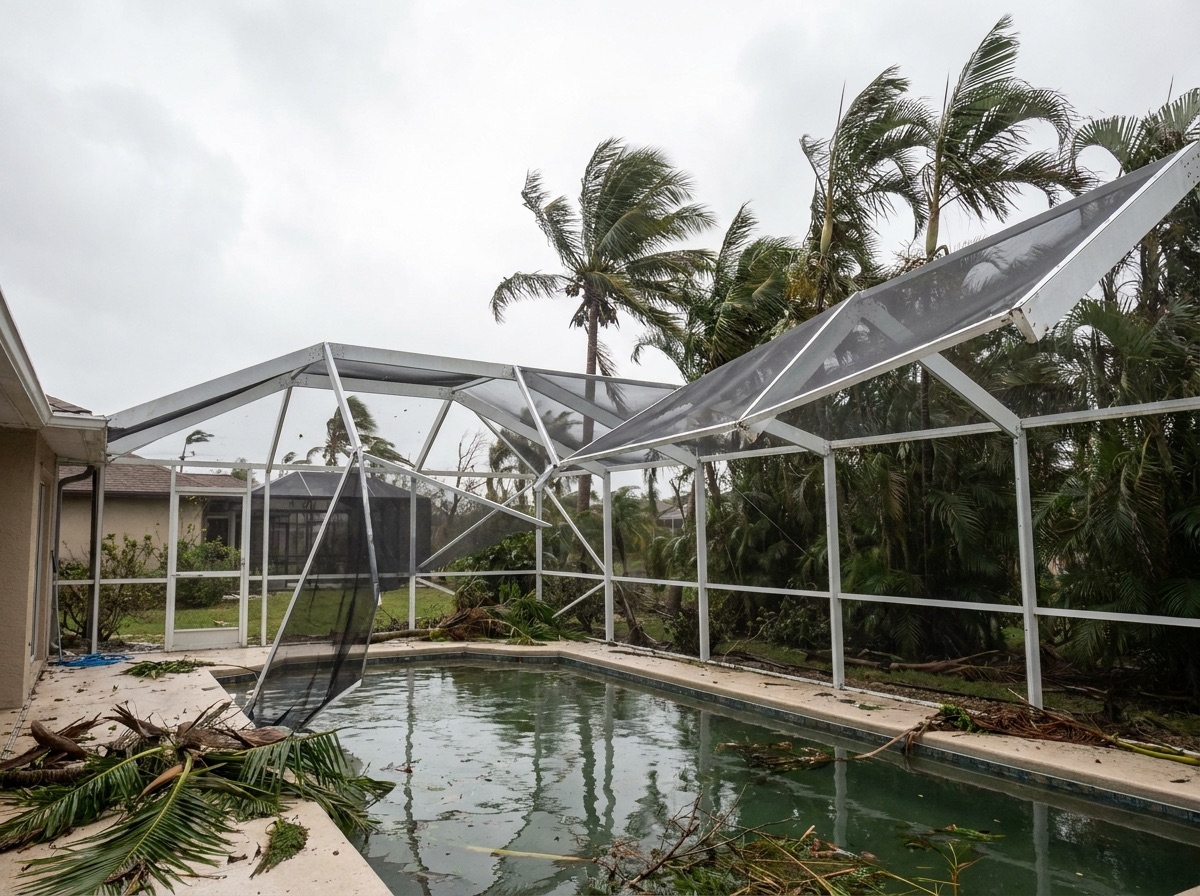
Aluminum Frame Repair in St. Petersburg
Straightening or replacing bent and broken aluminum enclosure framing. We connect St. Petersburg homeowners with vetted, licensed local pros, free.
Aluminum Frame in St. Petersburg
Free, no obligation. We match you with up to two licensed, insured local pros so you can compare.
- Licensed pros
- Free, no spam
- One call, not eight
Got it. You are in good hands.
A vetted local pro will reach out shortly. For an active emergency, call us now at (813) 555-0911.
St. Petersburg homeowners turn to aluminum frame repair after the storms that hit Pinellas County. Here is exactly what the work involves, what it costs, and how to get matched with a local pro.
Aluminum frame repair addresses the structural skeleton of a Florida screen enclosure after hurricane or severe storm damage. Unlike simple re-screening, frame repair requires a licensed contractor to assess which extrusions have buckled beyond tolerance, which corner connectors have sheared, and whether the main beam or hip rafters have deflected out of plane. Mild single-member bends can sometimes be hydraulically straightened in place, but Florida's humid salt-air environment means aluminum that has been permanently kinked or creased will corrode at the damage point and fail again - replacement of the affected member is typically the correct call. Because pool screen enclosures are attached to the home's concrete deck and often to the soffit or fascia, frame damage also creates a pathway for water intrusion if left unaddressed after a storm.
When you need itSigns you need this service
- One or more vertical or horizontal aluminum members are visibly bent, bowed, or twisted after a hurricane or tropical storm
- Corner connectors or gusset plates have cracked or separated, causing panels to rack out of square
- The main ridge beam or a hip rafter has deflected downward, causing the roof screen panels to sag or pool water
- Framing has pulled away from the concrete deck anchors or from the soffit attachment point
- Screen panels will not stay seated in the frame channel after a storm, suggesting the extrusion itself is deformed
- Previous repairs used mismatched or undersized extrusion profiles that are now failing under normal wind load
How it works
- Structural damage assessmentA contractor walks the entire enclosure perimeter and roof plane, documenting every member with visible deflection, cracked welds, sheared fasteners, or compromised anchor points. Photos and measurements are taken for both repair scope and any insurance documentation you choose to compile.
- Material sourcing and match verificationFlorida enclosures use region-specific extruded aluminum profiles - typically 1" x 1" or 2" x 2" square tube in 6005-T5 or 6063-T5 alloy. The contractor sources matching extrusion sizes and gauge to maintain the original structural load ratings. Mismatched profiles create weak points at splices.
- Containment and disassemblyScreen panels adjacent to damaged frame members are carefully removed and set aside or replaced if torn. Damaged extrusions are unbolted from connectors and deck anchors. For main beam or hip rafter damage, temporary shoring may be required to prevent roof panel collapse during repair.
- Frame member replacement or straighteningReplacement members are cut to length, drilled for fastener patterns, and installed with stainless-steel or hot-dip galvanized hardware appropriate for Florida's salt-air exposure. Hydraulic straightening is only performed on members with minor single-plane bends where the wall thickness is uncompromised.
- Re-anchoring and torque verificationDeck anchors and soffit attachment points are re-set to current Florida Building Code requirements. Anchor torque is verified to ensure the repaired frame meets the wind-load rating specified for the enclosure's county wind zone.
- Re-screening and final inspectionNew or salvaged screen panels are reinstalled in the repaired frame. The contractor performs a final walk to confirm all members are plumb and true, all fasteners are tight, and no gaps exist at panel edges that would allow pest entry or water channeling.
What it costs
The dominant cost drivers are linear footage of frame requiring replacement, extrusion profile size (larger hip rafters and ridge beams cost more per foot than standard infill members), and post-storm contractor availability. Simple corner repairs or single-member replacement typically run $800 - $2,000. Mid-range jobs involving multiple infill members plus one structural rafter run $2,000 - $4,000. Extensive damage to ridge beams, main posts, or widespread hurricane racking across a large pool enclosure can reach $4,000 - $6,000 or more before accounting for re-screening.
Aluminum Frame in St. Petersburg: questions
Do you offer aluminum frame in St. Petersburg?
Yes. We connect St. Petersburg homeowners with vetted, licensed local pros for aluminum frame repair, with a free assessment and no obligation.
How fast can someone help with aluminum frame in St. Petersburg?
For St. Petersburg and the surrounding Pinellas County area, our network pros prioritize storm work and typically respond same-day or next-day for urgent needs.
Can a bent aluminum frame member be straightened rather than replaced?
Minor single-plane bends in infill members - where the aluminum has flexed but the wall of the tube is still intact - can sometimes be carefully straightened with a hydraulic press or bending jig. However, any member that has kinked, creased, or buckled (where the tube wall has folded inward) must be replaced. A kinked extrusion has lost its cross-sectional rigidity and will fail at a lower wind load than the original rating, creating a liability on the next storm. In Florida's storm frequency environment, most contractors default to replacement over straightening for anything beyond very minor bends.
Does aluminum frame repair also include replacing the screen mesh?
Not automatically. Frame repair addresses the structural skeleton - the extrusions, connectors, and anchors. Screen mesh is a separate line item. If the mesh in panels adjacent to damaged framing is torn, most contractors will quote re-screening those panels alongside the frame work since the panels are already dismantled. Mesh that is intact and undamaged is typically reinstalled in the repaired frame without charge.
How do I know if my enclosure needs frame repair versus full replacement?
The threshold is generally structural. If damage is confined to a few infill members and the main ridge beam, hip rafters, and corner posts are straight and properly anchored, repair is almost always the right call economically. If the ridge beam has permanently deflected, multiple main posts are bent at the base, or deck anchors have pulled out of the concrete across more than a third of the perimeter, full replacement may be necessary and cost-comparable to extensive repair. A licensed contractor's written scope is the clearest way to get that answer.
What aluminum alloy and gauge should replacement members use?
Most Florida residential enclosures were built with 6005-T5 or 6063-T5 extruded aluminum in 0.060" or 0.080" wall thickness, depending on the span and wind zone. Replacement members should match the original specification. Using a thinner wall gauge or a softer alloy temper to save cost creates a repair that will fail before the rest of the structure under hurricane-force wind loads.
How long does frame repair typically take?
A straightforward repair involving a handful of infill members on a standard pool enclosure can be completed in one day. Repairs involving structural rafters or main posts where temporary shoring is required typically take two to three days. After a named storm in Florida, contractors are heavily backlogged - post-hurricane waits of four to twelve weeks are common for non-emergency repairs, so scheduling early matters.
Is aluminum frame repair covered by homeowners insurance?
Screen enclosures are a covered structure under most Florida homeowners policies, and many policies include a specific coverage sublimit for screen enclosures - often $10,000. Whether a given repair is covered depends on the cause of loss, the policy terms, and whether it meets your deductible. Document the damage with photos and dates tied to the storm event and consult your policy for the applicable coverage provisions and any filing deadlines.
What hardware should be used in salt-air coastal Florida locations?
Standard zinc-plated fasteners corrode rapidly in coastal Florida's salt-air environment and can cause aluminum extrusions to seize or spall within a few years. Replacement work in coastal areas should use 304 or 316 stainless-steel screws and bolts, or hot-dip galvanized hardware where stainless is not available. This is particularly important at deck anchors, which are difficult to access for future maintenance.
Does Florida require a permit for screen enclosure frame repair?
Permit requirements vary by county and municipality. Many Florida jurisdictions require a permit for structural repairs to screen enclosures - particularly when replacing load-bearing members such as hip rafters, ridge beams, or perimeter posts - because the work must meet Florida Building Code wind-load requirements for the enclosure's wind zone. Some counties have simplified post-hurricane permitting processes that reduce wait times. Confirm with your local building department before work begins.
Can I use a general handyman for aluminum frame repair, or do I need a licensed contractor?
Florida law requires a licensed contractor for structural repair work on screen enclosures, which includes frame member replacement. Unpermitted work by an unlicensed individual can create problems during a future home sale inspection and may affect your ability to document a subsequent storm loss. Verify that any contractor you hire holds a current Florida Building Contractor or Aluminum Contractor license.
How can I prevent this type of damage in future storms?
No aluminum frame enclosure is wind-proof in a direct hurricane hit, but several steps reduce risk. Ensure your enclosure was originally permitted and built to the Florida Building Code wind speed for your county. Check that all deck anchors are embedded into the concrete with the correct embedment depth - shallow anchors are the most common failure point. Remove or secure patio furniture inside the enclosure before a storm, since blowing furniture is a common cause of frame damage that is separate from pure wind loading.